Meta's $26 Million Lobbying Blitz Reshapes AI Policy Landscape
Episode Summary
TOP NEWS HEADLINES AI lobbying just fundamentally changed Washington. Meta spent $26. 3 million in 2025, and we're seeing the entire tech policy debate shift from privacy fights to national securi...
Full Transcript
TOP NEWS HEADLINES
Meta spent $26.3 million in 2025, and we're seeing the entire tech policy debate shift from privacy fights to national security and infrastructure.
This isn't gradual—AI has completely swallowed traditional tech lobbying.
The first major AI startup implosion of 2026 just played out.
Mira Murati's Thinking Machines Lab fell apart after CTO Barrett Zoph confronted her about company direction, got fired, then watched nine employees follow him to OpenAI where Sam Altman had been talking to them for months.
The $50 billion valuation they were targeting never materialized.
Google just hired Hume AI's entire leadership team—CEO and seven engineers—in a licensing deal to upgrade Gemini's emotional intelligence.
This is the latest acqui-hire following their $3 billion Character AI move, and it signals voice is becoming the critical battleground for AI assistants.
Apple made the biggest strategic retreat in AI we've seen.
They're paying Google $1 billion annually to use Gemini models as the foundation for Siri and Apple Intelligence, completely abandoning their build-it-ourselves approach after years of falling behind.
Research shows 90% of people can no longer distinguish AI-generated video from real footage.
Runway's study tested over a thousand participants with their Gen-4.5 model, and the implications for truth and verification are staggering—seeing truly is no longer believing.
DEEP DIVE ANALYSIS
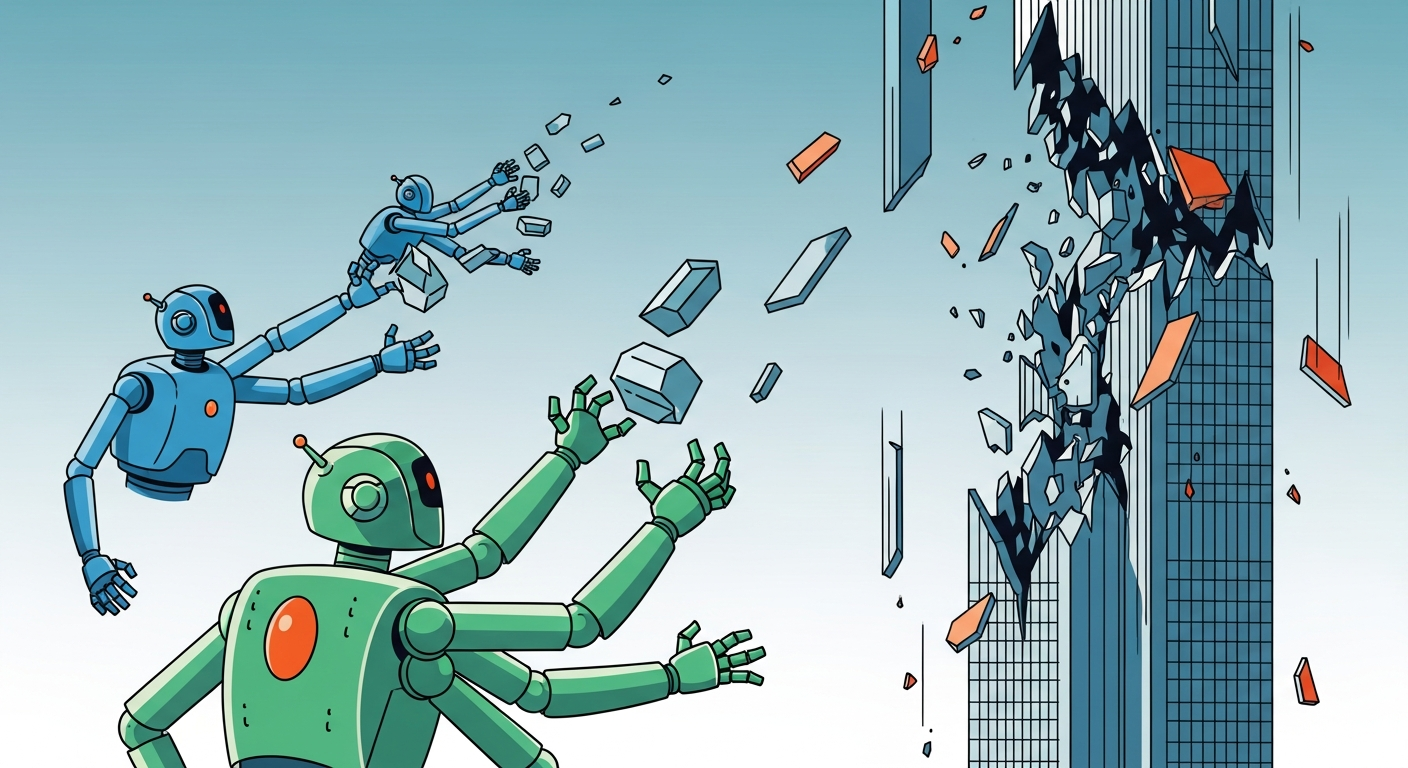
The Thinking Machines Meltdown: Inside AI's First Major Talent War Casualty The spectacular collapse of Mira Murati's Thinking Machines Lab isn't just startup drama—it's a case study in how the AI talent wars are creating a new kind of corporate warfare where the traditional rules don't apply. TECHNICAL DEEP DIVE Here's what actually happened behind the scenes. Barrett Zoph, who helped build Google's Transformer architecture and was Thinking Machines' CTO, had been secretly talking to Sam Altman for months while working at TML.
This wasn't casual networking—these were detailed discussions about technical direction and team composition. When Zoph and two other co-founders confronted Murati about wanting control of technical decisions, she reportedly told him to "just do his job" and fired him days later. The technical implications run deeper than personnel shuffles.
TML was trying to build advanced reasoning models to compete directly with OpenAI, but they were struggling to raise at their target $50 billion valuation. The company had fundamental disagreements about technical direction—Zoph and others wanted to pursue a sale to Meta, while Murati resisted. This speaks to a broader challenge: building frontier AI models requires not just technical talent, but unified vision about commercialization strategy.
When those diverge, the technical roadmap falls apart because you're optimizing for different outcomes. What makes this particularly significant is that OpenAI swooped in immediately with offers to nine TML employees and installed Zoph to lead their enterprise AI sales strategy. This wasn't opportunistic—it was planned.
OpenAI essentially executed a talent acquisition strategy through sustained relationship-building, then activated it the moment internal tensions peaked. FINANCIAL ANALYSIS The financial mechanics of this collapse reveal how AI company valuations are becoming increasingly disconnected from traditional startup metrics. Thinking Machines was targeting a $50 billion valuation—a staggering number for a company that hadn't shipped a product.
That valuation was based purely on team pedigree and the assumption that frontier AI capabilities command premium multiples. But here's the problem: frontier AI is becoming a scale game that only a handful of companies can play. The capital requirements are astronomical—OpenAI is projecting $115 billion in capital spending by 2029 and burned through an estimated $9 billion in compute costs alone in 2025.
Mid-tier startups like TML face an impossible position. They can't raise enough to truly compete on model capabilities, but they're too expensive for strategic acquirers who can just hire the talent directly. The Meta acquisition discussions that fell through are particularly revealing.
Meta apparently wasn't willing to pay anywhere near $50 billion, likely because they could assess the actual technical moat—which was minimal. When your primary asset is talent that can be poached, and when that talent is actively talking to competitors, you don't have a business, you have a temporary employment arrangement. The immediate aftermath shows the new financial logic: OpenAI gets proven AI researchers without paying acquisition premiums, the employees get to work at the frontier with virtually unlimited resources, and the original company evaporates.
This is going to become the standard pattern for AI startups that can't achieve escape velocity. MARKET DISRUPTION This meltdown accelerates a trend we're seeing across AI: vertical consolidation around a handful of frontier labs. The market is bifurcating into companies that can spend $10+ billion annually on compute and infrastructure, and everyone else.
There's increasingly no middle ground. Look at what happened to TML's positioning. They were trying to compete on advanced reasoning capabilities—the exact area where OpenAI, Anthropic, and Google are spending billions.
Without a clear differentiation strategy or unique data advantage, they were essentially trying to out-execute incumbents who have better models, more compute, and deeper pockets. That's not a competitive position, it's a death spiral. The talent war dynamics are creating a new form of anti-competitive behavior that isn't illegal but is devastating to startups.
Large labs can maintain ongoing relationships with talent at competitors, wait for internal tensions to surface, then execute coordinated hiring raids. This happened to Inflection AI, where nearly the entire team went to Microsoft. It happened to Character AI with Google.
Now it's happened to Thinking Machines with OpenAI. For venture investors, this should be terrifying. If you're funding an AI startup, you're essentially betting that team cohesion will survive the sustained pressure of incumbents offering unlimited resources and the chance to work on truly frontier problems.
When co-founders start disagreeing about strategic direction, the company doesn't get acquired—it gets dismantled for parts. CULTURAL AND SOCIAL IMPACT The personal dynamics in this story matter because they reflect broader cultural tensions in AI development. Murati's alleged response to Zoph—"just do his job"—speaks to fundamental questions about technical versus business leadership in AI companies.
In traditional tech, that hierarchy might work. In AI, where the technology is advancing so rapidly that technical decisions are existential business decisions, it doesn't. This also exposes the myth of the heroic founder in AI.
Murati had enormous credibility coming from OpenAI, where she was CTO during ChatGPT's launch. But credibility doesn't translate to the ability to navigate the specific challenges of frontier AI development: balancing research freedom with commercial timelines, managing massive compute budgets, and maintaining team cohesion when competitors are constantly recruiting. The speed of the collapse—from confrontation to firing to mass exodus in days—shows how fragile these organizations are.
When your primary asset is human capital and that capital is globally mobile, organizational culture isn't a nice-to-have, it's structural integrity. TML didn't just lose employees, it lost its reason to exist the moment Zoph left. EXECUTIVE ACTION PLAN First, if you're running an AI company or evaluating AI investments, implement "talent flight risk" as a core metric.
Monitor how often key technical staff are being contacted by competitors, track their engagement levels, and create financial and technical incentive structures that make leaving genuinely costly. Stock options don't cut it anymore—you need golden handcuffs that include multi-year research roadmaps and compute allocations. Second, recognize that the AI startup landscape has fundamentally changed.
The window for mid-market AI companies—those trying to compete on foundation models without hyperscaler resources—has effectively closed. If you're investing in or building AI companies, the only viable strategies are either solving narrow vertical problems with fine-tuned models, or building application layers on top of existing foundation models. Trying to compete directly with OpenAI, Google, or Anthropic on general capabilities is now suicide.
Third, for enterprises choosing AI partners, the Thinking Machines collapse should inform your vendor selection criteria. Favor established players or startups with clear paths to sustainable differentiation. Be extremely wary of AI companies that position themselves as "we're building the next frontier model"—unless they can articulate massive capital commitments and retention strategies for key talent, they're likely to evaporate.
Your integration work could become worthless overnight when the talent walks and the company shutters. Build your AI strategy around partners who will definitely exist in eighteen months, because in this market, that's no longer a given.
Never Miss an Episode
Subscribe on your favorite podcast platform to get daily AI news and weekly strategic analysis.