Meta Commits $600 Billion to AI Infrastructure Over Metaverse
Episode Summary
TOP NEWS HEADLINES Following yesterday's coverage of Anthropic's xAI blockade and Claude Cowork launch, new details emerged: the company has launched Anthropic Labs as an experimental product incu...
Full Transcript
TOP NEWS HEADLINES
Following yesterday's coverage of Anthropic's xAI blockade and Claude Cowork launch, new details emerged: the company has launched Anthropic Labs as an experimental product incubator, bringing on Instagram co-founder Mike Krieger to lead the division while Ami Vora takes over as Chief Product Officer to scale core Claude experiences.
Apple's Gemini integration just got more interesting.
We learned the company will fine-tune Gemini models independently for specific responses, with zero Google or Gemini branding visible to users.
Initial features launch this spring, with more advanced capabilities coming at the developer conference in June.
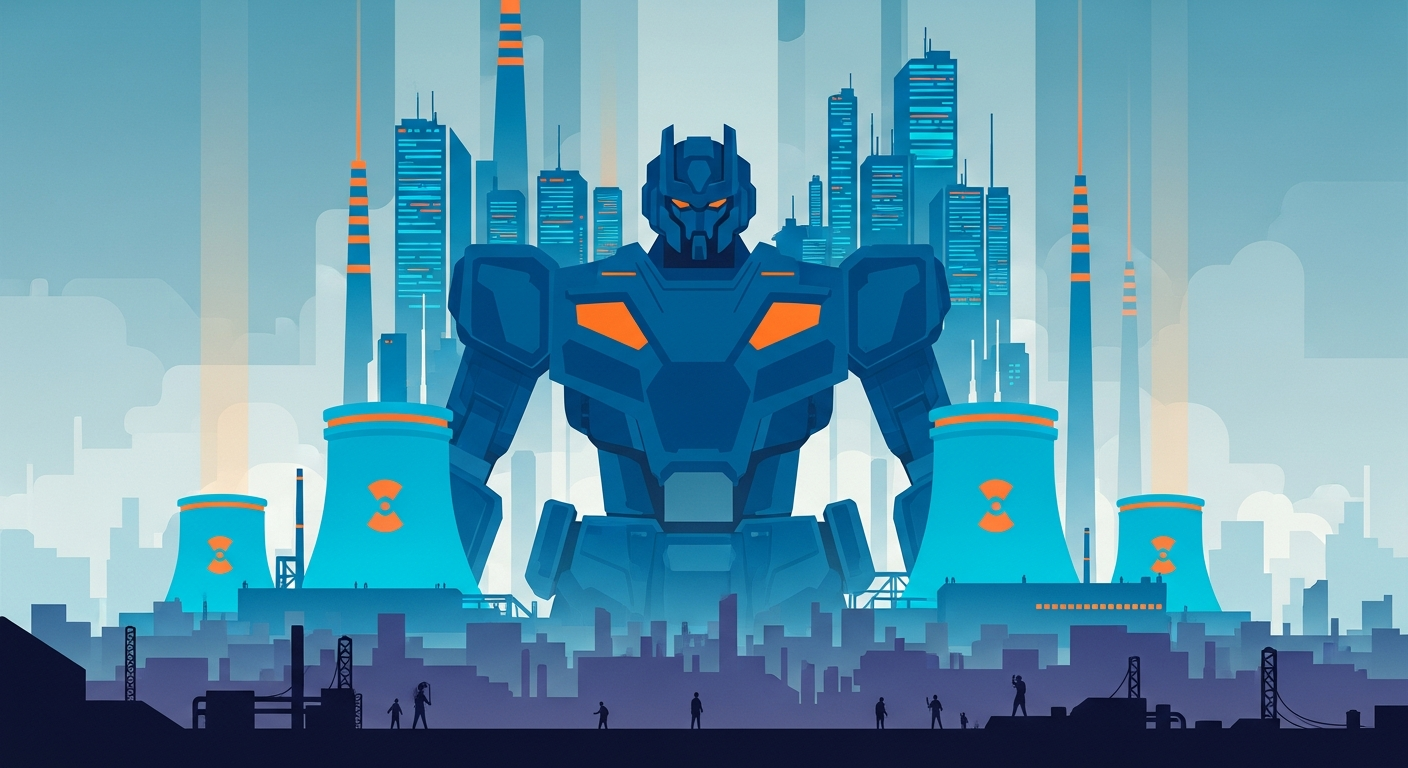
Mark Zuckerberg just announced Meta Compute, a massive infrastructure initiative planning to build tens of gigawatts of AI capacity this decade and hundreds of gigawatts over time.
The company's committing 600 billion dollars in US infrastructure spending by 2028, with nuclear power agreements already locked in.
This comes as Meta cuts about 10% of its Reality Labs division, essentially sacrificing the metaverse for superintelligence.
DeepSeek unveiled Engram, a new architecture that stores knowledge in system RAM instead of GPU memory.
This could be huge for solving the high-bandwidth memory supply bottleneck that's been constraining AI development.
And Google shipped major updates to Veo 3.1, adding reference image support, native vertical video for mobile platforms, and 4K upscaling capabilities across Gemini, YouTube, and Vertex AI. --- DEEP DIVE ANALYSIS: META'S $600 BILLION INFRASTRUCTURE PIVOT
Technical Deep Dive
Meta Compute represents a fundamental shift in how the company thinks about AI infrastructure at scale. The initiative, co-led by infrastructure chief Santosh Janardhan and Daniel Gross from AI safety startup SSI, plans to add tens of gigawatts of capacity this decade. To put that in perspective, a single gigawatt can power about 750,000 homes.
We're talking about power consumption that rivals small countries. The technical bet here is clear: Meta believes the path to artificial general intelligence is a straight line of compute scaling. They've already locked in 20-year nuclear power agreements for their data centers, showing they're not just thinking in quarterly increments but in decades.
This isn't about running today's Llama models more efficiently. This is about having enough infrastructure to train models orders of magnitude larger than anything we've seen. The timing matters too.
This announcement comes right after former chief AI scientist Yann LeCun left and publicly claimed Meta "fudged" Llama 4 benchmarks by mixing model versions. The company is essentially saying: we're done with incremental improvements and benchmark games. We're going all-in on raw computational power.
Financial Analysis
Six hundred billion dollars in infrastructure spending by 2028 is staggering, even for Meta. For context, that's more than the GDP of Sweden. This represents the largest capital expenditure commitment in the company's history, dwarfing the estimated 100 billion they spent on the metaverse before pulling the plug.
The economics only work if Meta believes AI infrastructure will generate returns that justify this investment within a reasonable timeframe. They're betting on one of two scenarios: either AI services become so valuable that charging for them covers the cost, or AI-enhanced products drive enough engagement and advertising revenue to make the math work indirectly. The simultaneous announcement of Reality Labs layoffs affecting roughly 1,000 employees tells you everything about capital reallocation.
Zuckerberg is moving billions from a consumer hardware bet that failed to materialize into pure AI compute infrastructure. Wall Street should watch Meta's capital expenditure carefully over the next few quarters. If they're serious about this timeline, we should see billions flowing into data center construction and energy contracts immediately.
The nuclear power agreements are particularly interesting financially. They provide price certainty for decades, which matters when you're trying to model the economics of running massive AI training runs. Variable energy costs could make or break the unit economics of frontier AI development.
Market Disruption
This move fundamentally changes the competitive landscape in AI. Meta is declaring that infrastructure won't be their bottleneck. While OpenAI negotiates for compute credits from Microsoft and Anthropic relies on cloud providers, Meta is building its own vertical stack of power generation and data centers.
The appointment of 28-year-old Alexandr Wang from Scale AI to replace Yann LeCun signals another competitive shift. Wang built Scale into the dominant data labeling company for AI, and now he's running Meta's superintelligence labs. This isn't just a talent acquisition.
It's Meta absorbing the expertise of a company that's been instrumental in training virtually every frontier model from competitors. For the broader AI industry, Meta's infrastructure play creates a new competitive moat. Startups and smaller players simply cannot match this level of capital commitment.
We're watching AI development bifurcate into two tiers: companies with their own massive infrastructure and everyone else renting from cloud providers. The metaverse pivot also sends a signal to the market: consumer AR and VR hardware is now considered a distraction. Apple's Vision Pro is competing in a category that Meta just publicly deprioritized.
That's either terrible timing for Apple or validation that Meta made the right call to exit.
Cultural & Social Impact
The death of the metaverse at Meta represents more than a business pivot. It's the end of a particular vision of how humans would interact with technology. Zuckerberg spent years evangelizing spatial computing and virtual worlds as the next platform.
Now that vision is being sacrificed for artificial superintelligence. This matters culturally because it shifts what Silicon Valley is building toward. Instead of creating immersive virtual spaces for human connection, the focus is now on creating artificial minds that might surpass human intelligence.
That's a fundamentally different relationship between humans and technology. The power consumption is worth examining too. Hundreds of gigawatts of capacity for AI training means Meta will soon consume more electricity than entire US states.
This raises legitimate questions about energy priorities and climate impact. Yes, they're using nuclear power, which is carbon-free, but the sheer scale of resources devoted to training AI models instead of other societal needs is unprecedented. There's also a consolidation of power happening.
The companies that can afford this level of infrastructure investment will control the foundational models that everyone else builds on. Meta joining OpenAI, Google, and Anthropic in the "we have our own massive compute" category means the AI industry is rapidly stratifying into haves and have-nots.
Executive Action Plan
**First, if you're building on AI models, diversify your infrastructure dependencies immediately.** Meta's move toward self-sufficiency means the major AI providers are increasingly competing on infrastructure, not just model quality. Don't build your business on a single provider's API.
Have fallback options ready, because pricing and availability could shift rapidly as these companies optimize for their own strategic priorities rather than third-party developers. **Second, if you're in energy-intensive industries, start studying AI companies' energy procurement strategies now.** Meta's nuclear power agreements show that large-scale, long-term energy contracts are becoming a competitive advantage.
Whatever your industry, if you consume significant power, the playbook of locking in decades-long agreements with stable pricing deserves serious consideration. The AI companies are going to absorb enormous amounts of energy capacity, and they're doing it through strategic partnerships that smaller players can't match. **Third, watch for the talent migration.
** When a company commits 600 billion dollars to an initiative, the best engineers follow. If you're trying to recruit AI talent, you're now competing with Meta's blank check approach to building superintelligence. Consider what makes your opportunity unique beyond compensation, because you cannot outspend this level of commitment.
Focus on technical challenges, research freedom, or mission alignment that large-scale infrastructure plays can't offer.
Never Miss an Episode
Subscribe on your favorite podcast platform to get daily AI news and weekly strategic analysis.