NVIDIA and Eli Lilly Launch Billion-Dollar AI Drug Discovery Partnership
Episode Summary
TOP NEWS HEADLINES Apple and Google just made it official: Gemini is powering the next generation of Siri. After months of speculation, they've confirmed a multi-year deal where Google's AI will b...
Full Transcript
TOP NEWS HEADLINES
Apple and Google just made it official: Gemini is powering the next generation of Siri.
After months of speculation, they've confirmed a multi-year deal where Google's AI will become the foundation for Apple's intelligence features.
This isn't just about Siri getting smarter—it positions Google as the infrastructure provider for one of the world's largest tech ecosystems, while Apple's ChatGPT partnership suddenly looks like a side project.
Following yesterday's coverage of Apple's nuclear energy expansion, Meta just formalized its infrastructure push with Meta Compute.
The company appointed Dina Powell McCormick as President and Vice Chairman to lead partnerships with governments worldwide, aiming to build tens of gigawatts of capacity this decade.
Zuckerberg is betting that infrastructure control will be Meta's competitive moat.
Anthropic launched Cowork, bringing Claude Code's agentic capabilities to everyone.
It's Claude Code without the code—a simpler interface that lets non-technical users assign a folder and watch Claude organize files, build reports, and manage workflows autonomously.
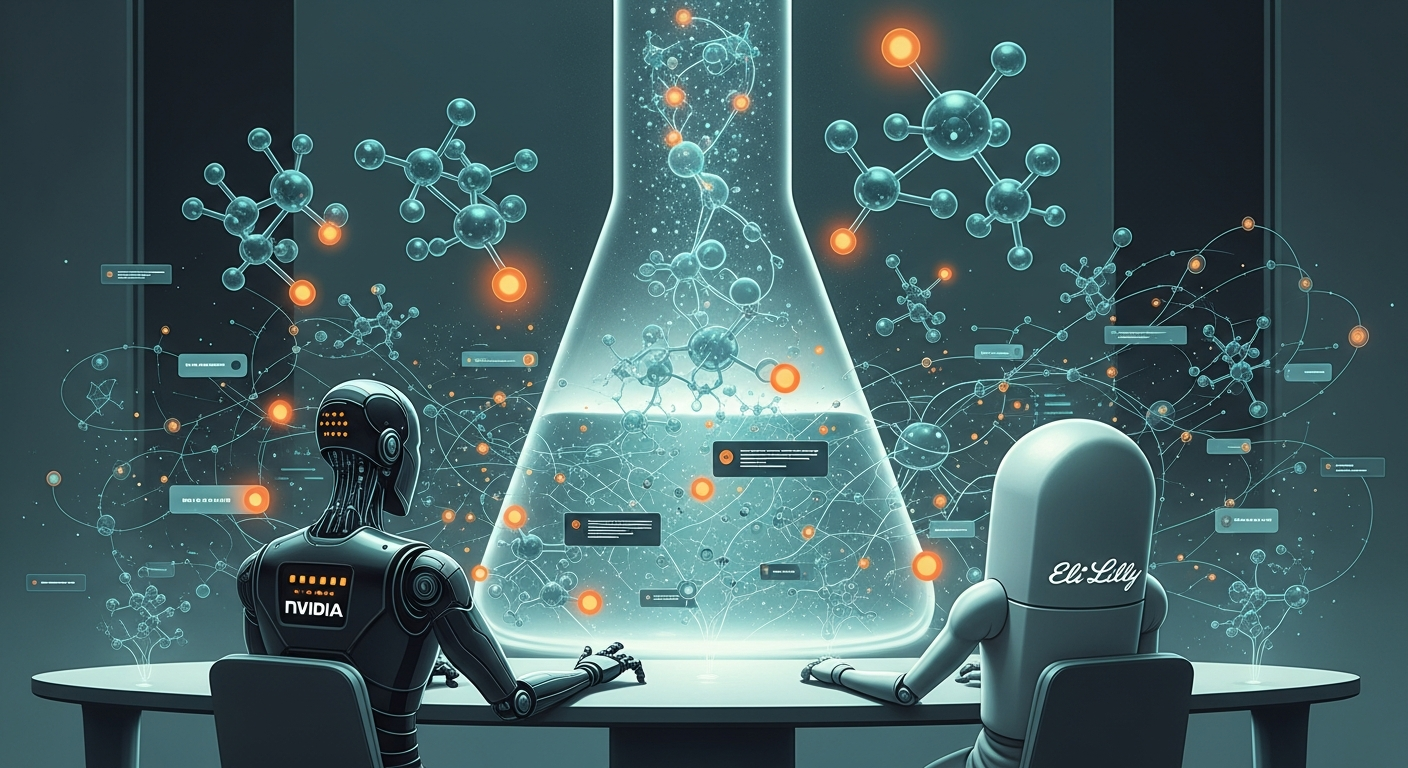
NVIDIA and Eli Lilly are committing one billion dollars over five years to build a joint AI drug discovery lab in Silicon Valley.
This represents a major convergence of pharma and AI, with NVIDIA making its BioNeMo platform open source to accelerate the industry.
IBM's Granite 4.0 just scored a 95 on Stanford's Transparency Index—the highest ever recorded.
Their new Nano models run at 90 tokens per second on your phone, and they're the first major AI developer to earn ISO 42001 certification.
AI should be boring like electricity—reliable infrastructure, not a potential deity.
DEEP DIVE ANALYSIS: NVIDIA AND ELI LILLY'S BILLION-DOLLAR BET ON AI DRUG DISCOVERY
Technical Deep Dive
NVIDIA and Eli Lilly's billion-dollar collaboration represents a fundamental shift in how we approach pharmaceutical research. At the core of this partnership is NVIDIA's BioNeMo platform, a comprehensive suite of AI tools designed specifically for drug discovery that the company is now making open source. The technical challenge they're solving is enormous.
Traditional drug discovery relies on what researchers call "wet lab feedback loops"—physical experiments that can take weeks or months to yield results. Each iteration requires actual chemical synthesis, cellular testing, and biological validation. This creates a massive bottleneck where AI models must wait extended periods to learn whether their predictions were accurate.
BioNeMo addresses this by creating digital twins of biological systems. Instead of waiting for lab results, researchers can simulate molecular interactions, predict protein folding, and model drug-target binding in silico. The platform combines multiple AI architectures: transformer models for understanding protein sequences, diffusion models for generating novel molecular structures, and reinforcement learning systems that improve predictions based on experimental outcomes.
The Silicon Valley location is strategic. By placing pharmaceutical researchers directly alongside AI engineers, they're creating a feedback loop between those who understand drug development constraints and those who can architect AI systems. This co-location model allows AI teams to observe actual lab workflows, understand failure modes in real-time, and rapidly iterate on models based on researcher feedback—something that's impossible when these groups are separated by thousands of miles.
Financial Analysis
The billion-dollar investment breaks down to roughly 200 million annually over five years, but the financial implications extend far beyond the headline figure. For NVIDIA, this represents a masterclass in platform economics. By making BioNeMo open source, they're not giving away value—they're creating demand for their hardware.
Here's the business model: pharmaceutical companies worldwide will adopt BioNeMo because it's free and backed by Eli Lilly's validation. But running these models at scale requires enormous computational power, specifically the type of GPU infrastructure that only NVIDIA provides. It's the razors-and-blades model applied to AI infrastructure.
The open-source platform is the razor; the H100 and B100 GPU clusters are the blades. For Eli Lilly, the math is equally compelling. The pharmaceutical industry averages 2.
6 billion dollars to bring a single drug to market, with a 90% failure rate. If AI-driven discovery can reduce either the cost per candidate or increase the success rate even marginally, the ROI becomes astronomical. A 10% improvement in success rates across Lilly's pipeline could generate tens of billions in additional revenue.
The partnership also creates a defensive moat. By controlling cutting-edge AI drug discovery infrastructure, Lilly gains a 3-5 year lead over competitors who will need to build similar capabilities. In an industry where patent cliffs and generic competition constantly threaten margins, this technological advantage translates directly to sustained pricing power.
Investors should note the broader signal: NVIDIA is systematically capturing the AI infrastructure layer across industries. They've done it in autonomous vehicles with DRIVE, in robotics with Isaac, and now in pharmaceuticals with BioNeMo. This vertical integration strategy significantly reduces their exposure to commodity GPU pricing pressure.
Market Disruption
This partnership fundamentally restructures competitive dynamics in both pharmaceutical development and AI infrastructure. For Big Pharma, the message is clear: AI capability is no longer optional. Companies without equivalent partnerships or internal AI labs will find themselves at a compound disadvantage—their discovery timelines will be slower, their R&D costs higher, and their pipeline success rates lower.
The immediate competitive response is already visible. Expect Pfizer, Merck, and Johnson & Johnson to announce similar partnerships within six months. But here's the catch: there aren't many NVIDIA-caliber AI infrastructure providers.
This creates a "musical chairs" dynamic where late movers may be forced into less advantageous arrangements or need to build capabilities internally at significantly higher cost. For AI-native biotech startups like Recursion Pharmaceuticals, Insitro, and Genesis Therapeutics, this is double-edged. The NVIDIA-Lilly partnership validates their entire thesis—AI can revolutionize drug discovery.
But it also means they're now competing directly against incumbents with 10-100x their resources. Their survival depends on finding defensible niches or therapeutic areas where size doesn't translate to advantage. The CRO (Contract Research Organization) industry faces existential disruption.
Companies like Labcorp and Charles River Laboratories built businesses around providing research services to pharmaceutical companies. When AI can simulate many of these services faster and cheaper, the entire economic model collapses. Those that don't pivot to AI-enhanced services will face steady margin compression.
Perhaps most significantly, this signals that the "AI automation of physical science" thesis is entering its commercial phase. We're witnessing the beginning of AI's expansion from purely digital domains—where it's already achieved superhuman performance—into physical domains requiring lab automation, robotic experimentation, and real-world validation.
Cultural & Social Impact
Beyond business implications, this partnership marks a cultural inflection point in how society approaches scientific discovery. For decades, pharmaceutical research has been the domain of PhD chemists and biologists working through systematic trial and error. That human-centric model is giving way to a hybrid approach where AI proposes candidates and humans validate them.
This raises profound questions about scientific understanding. When an AI suggests a novel drug candidate that works, but the mechanism isn't immediately clear to human researchers, do we use it? The answer increasingly is yes—and this represents a fundamental shift from "understanding-first" science to "outcomes-first" science.
We're entering an era where AI may discover effective treatments before humans fully comprehend why they work. For patients, the implications are overwhelmingly positive. Faster drug discovery means more treatment options for rare diseases that currently lack economic incentives.
AI's ability to analyze individual patient data could enable truly personalized medicine—not just choosing between existing drugs, but generating custom therapeutic candidates tailored to an individual's genetic profile. However, this also concentrates pharmaceutical innovation within a small number of companies with access to cutting-edge AI infrastructure. Smaller research institutions and developing nations may find themselves increasingly dependent on technologies they don't control.
The open-sourcing of BioNeMo partially addresses this, but computational requirements still favor well-resourced organizations. There's also the workforce transition. Thousands of medicinal chemists whose careers centered on manually designing drug candidates will need to evolve into "AI-assisted drug designers.
" This requires developing new skills in prompt engineering for molecular generation, interpreting AI predictions, and validating computational results against biological reality.
Executive Action Plan
**For Pharmaceutical Executives:** Stop treating AI as an R&D experiment and start treating it as core infrastructure. Allocate 15-20% of your R&D budget specifically to AI capabilities over the next 18 months. This isn't about replacing scientists—it's about giving them superpowers.
Identify three therapeutic areas where your pipeline is weakest and pilot AI-driven discovery programs immediately. Partner if you must, but begin building internal capability now. In three years, companies without AI-native drug discovery will be competitively disadvantaged in the same way companies without internet infrastructure were in 2005.
**For Healthcare Investors:** Reassess your biotech portfolios through an AI-capability lens. Companies with proprietary data assets—particularly rare disease patient data or unique biological datasets—become significantly more valuable because they can train specialized AI models competitors can't replicate. Conversely, traditional CROs and research service providers face structural headwinds.
Look for companies positioned at the intersection of AI and physical lab automation, as that's where the next bottleneck will emerge. NVIDIA's move into vertical-specific AI platforms also signals opportunity in picks-and-shovels plays around computational biology infrastructure. **For Technology Leaders in Other Industries:** This partnership provides a blueprint for AI adoption in complex, regulated, physical-world domains.
The key insight is co-location: putting AI engineers directly alongside domain experts in shared facilities. If you're in manufacturing, agriculture, or materials science, study this model. The winners in AI-enabled industries won't be pure AI companies or pure domain companies—they'll be genuine hybrids that integrate both capabilities at the organizational level.
Start planning now for how you'll create these integrated teams, because the competitive advantage compounds over years, not quarters.
Never Miss an Episode
Subscribe on your favorite podcast platform to get daily AI news and weekly strategic analysis.