GPT-5.2 Solves 30-Year-Old Math Problem, Reshaping Knowledge Work
Episode Summary
TOP NEWS HEADLINES GPT-5. 2 Pro just solved a 30-year-old mathematics problem that stumped researchers since 1996, with Fields Medalist Terence Tao verifying the proof as legitimate. This isn't an...
Full Transcript
TOP NEWS HEADLINES
GPT-5.2 Pro just solved a 30-year-old mathematics problem that stumped researchers since 1996, with Fields Medalist Terence Tao verifying the proof as legitimate.
This isn't an isolated incident—the model has now cracked three separate Erdős problems using formal verification tools.
NVIDIA is demanding cash upfront from Chinese customers ordering H200 chips, with no refunds allowed.
This signals growing supply constraints and escalating geopolitical risk in the chip trade.
Following yesterday's coverage of Google's Gmail Gemini integration, new details emerged: Google will penalize AI-bait content in search rankings, remove AI overviews for certain medical queries, and introduce personalized ads directly within AI Mode interactions.
Workday faces a lawsuit alleging its AI hiring tools systematically discriminate against job applicants over 40 years old.
The case is actively seeking additional plaintiffs before March 7th.
OpenAI reportedly asked contractors to upload real work from past and current jobs to generate training data specifically designed to automate white-collar tasks.
This confirms what many suspected about how frontier labs are building the next generation of workplace automation.
DEEP DIVE ANALYSIS
Technical Deep Dive
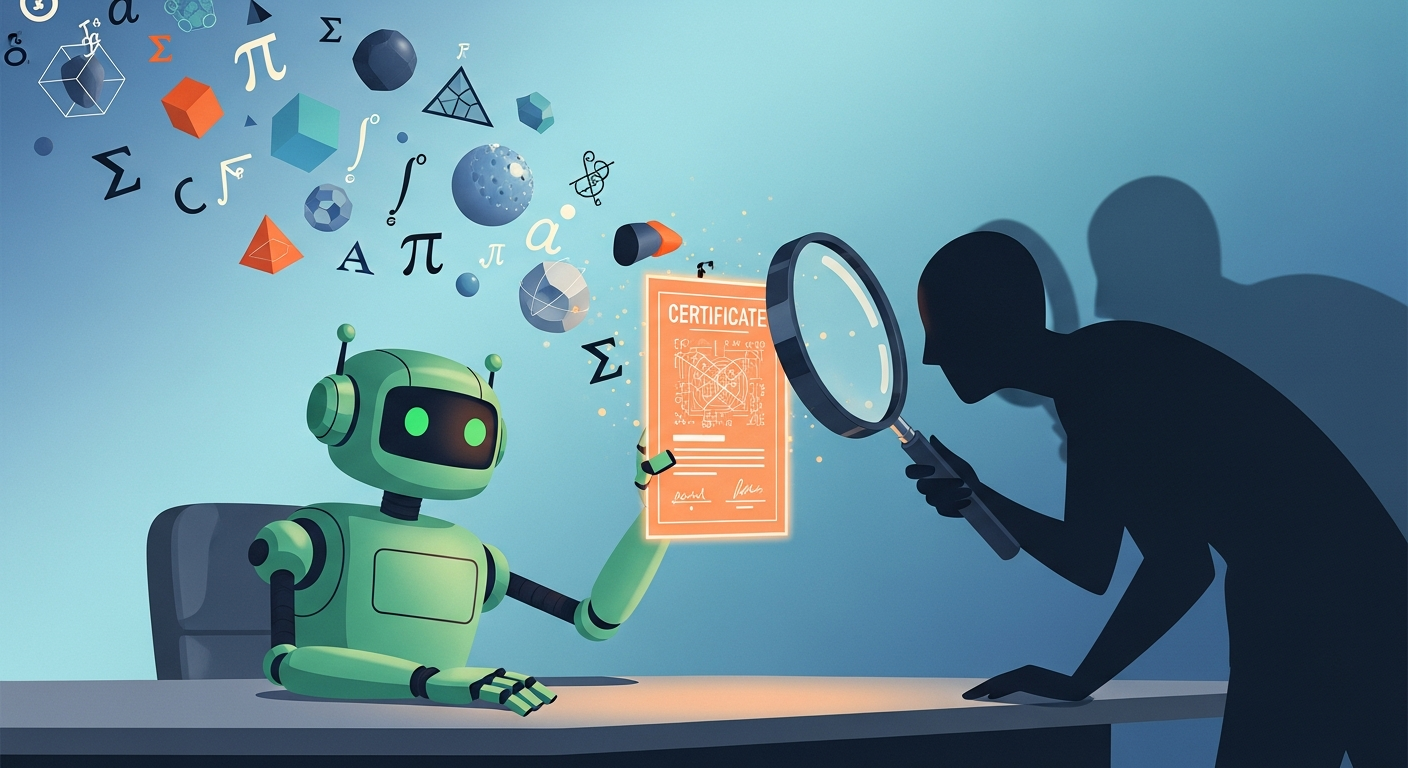
Let's talk about what actually happened here, because this represents a genuine inflection point in AI capabilities. GPT-5.2 Pro didn't just stumble onto an existing proof buried in some academic paper.
It generated an original mathematical proof for Erdős Problem #397—a question about whether infinitely many solutions exist for a specific equation involving central binomial coefficients. Here's what makes this technically significant: The AI used a tool called Aristotle to formalize its proof in Lean, which is a verification language mathematicians use to ensure absolute logical correctness. Think of Lean as a compiler for mathematical proofs—it catches errors the same way your code editor flags syntax mistakes.
The system actually auto-corrected gaps in the initial proof, iterating until it produced something that passed formal verification. Terence Tao, one of the world's top mathematicians, reviewed the proof and confirmed it's original work, not pattern-matching from existing literature. That distinction matters enormously.
Back in October 2025, GPT-5 caused controversy by essentially finding and repackaging existing research. This time, the model performed genuine mathematical reasoning—starting from first principles, applying standard techniques, and arriving at a novel solution. The catch, and Tao emphasizes this, is that these are what mathematicians call "low-hanging fruit.
" Problems that can be solved with established techniques, just ones that nobody got around to solving yet. GPT-5.2 scores 77% on competition-level mathematics but only 25% on truly open-ended research requiring creative insight.
Still, automated theorem proving has moved from theoretical possibility to demonstrated reality.
Financial Analysis
The immediate financial implications are subtle but far-reaching. We're witnessing AI transition from content generation to formal reasoning, which unlocks entirely new revenue opportunities for the companies that can deploy it effectively. OpenAI's approach here—formal verification integrated directly into their API—creates defensible value that's harder for competitors to replicate quickly.
Training models to interface with proof assistants like Lean requires specialized datasets and reinforcement learning from formal verification feedback. That's a moat that takes real engineering effort to cross. For professional services firms, this should trigger alarm bells.
Management consulting, legal review, regulatory compliance, contract analysis—any field involving structured logical reasoning is now squarely in AI's crosshairs. When a model can solve decades-old mathematical problems autonomously, reviewing a merger agreement or auditing financial controls becomes tractable in the next 12-18 months. The productivity multiplier here is significant.
If you're a quantitative research firm or engineering consultancy, you could deploy these systems to systematically work through your backlog of "we know this is solvable but nobody has time" problems. At scale, that's a competitive advantage that compounds. We're also seeing the emergence of a new software category: AI-native problem-solving platforms.
Aristotle, the verification tool used here, is one example. Expect venture capital to flow into startups building specialized reasoning tools for law, medicine, engineering, and finance. Companies like Observe getting acquired by Snowflake for $1 billion signals where this market is heading—AI tools that provide verifiable, auditable outputs command premium valuations.
Market Disruption
The competitive dynamics in AI just shifted. For the past two years, the race has been about training bigger models on more data. Now it's about reasoning architecture and verification systems.
Google, Anthropic, and the Chinese labs like Z.ai need to match OpenAI's capability here or risk being left behind in the enterprise market. Education and credentialing face existential questions.
If AI can solve graduate-level mathematics autonomously, what's the value proposition of a traditional STEM degree? Universities will need to pivot from teaching technique to teaching judgment, creativity, and problem formulation—the 25% of tasks these models still struggle with. Knowledge work platforms like Workday, which ironically is facing that age discrimination lawsuit, need to rapidly integrate these reasoning capabilities or watch AI-native competitors eat their lunch.
The same applies to legal tech, compliance software, and engineering design tools. Hardware manufacturers should pay attention too. NVIDIA's decision to demand cash upfront from Chinese customers shows how tight supply chains have become.
As reasoning models proliferate, inference costs will spike because these models require significantly more compute per query than simple text generation. That creates sustained demand for AI chips at premium prices. Here's the disruption nobody's talking about: the 660 remaining unsolved Erdős problems become a public benchmark for AI progress.
Every lab will start systematically attacking this problem set, similar to how they all competed on coding benchmarks. The first model to clear 50% of those problems will trigger another wave of market repricing.
Cultural & Social Impact
We need to talk about what this does to knowledge work as a cultural category. For decades, the ability to solve complex logical problems has been a marker of intellectual achievement and professional status. When machines can do this autonomously, it forces society to reconsider what types of intelligence we value.
There's a subtle psychological shift happening among knowledge workers. The initial reaction to AI was often dismissive—"it hallucinates," "it can't reason," "it's just autocomplete." Those defenses are evaporating.
When Terence Tao verifies that an AI generated an original mathematical proof, professionals in adjacent fields start questioning their own job security. That creates cultural anxiety but also opportunity. The democratization angle is significant.
A researcher anywhere in the world can now access reasoning capabilities that previously required collaboration with top-tier mathematicians. That could accelerate scientific progress, particularly in regions with less academic infrastructure. But it also risks widening gaps if only well-resourced organizations can afford enterprise access to these systems.
Education faces a reckoning. Students are already using AI to complete assignments, but now they can use it to solve genuinely difficult problems that require deep reasoning. Educators need to fundamentally redesign curricula around teaching students to formulate problems, evaluate AI-generated solutions, and develop intuition that machines lack.
Testing will need to become AI-native—assessing judgment and creativity rather than technique. There's also a question of attribution and credit. Neel Somani prompted the AI, Aristotle formalized the proof, GPT-5.
2 generated it—who gets credit for solving the problem? Academia and industry haven't figured out the norms yet, which will create friction as AI-assisted research becomes standard.
Executive Action Plan
If you lead a knowledge-intensive organization, here's what you need to do in the next 90 days: First, identify your "Erdős problems"—those challenges everyone in your industry knows about but nobody's solved because they require too much specialized reasoning effort. Create a structured repository of these problems with clear success criteria, similar to the JSON format used in the Ralph Wiggum agent workflow mentioned in the newsletter. Then systematically throw current-generation AI tools at them.
You'll get failures, but you'll also discover which problem categories are suddenly tractable. One executive I spoke with at a pharmaceutical company is doing exactly this with drug interaction modeling. The ROI is immediate if even 10% of those problems become solvable.
Second, start building internal expertise in formal verification tools. Lean is open source and the community is growing rapidly. Train a small team—three to five people—to translate your domain's quality standards into formal specifications.
This isn't just about AI; it's about creating machine-verifiable correctness criteria for your core work products. A financial services firm could apply this to compliance review. A manufacturing company could use it for safety analysis.
The point is establishing the infrastructure before your competitors do. Third, reassess your hiring and training strategy immediately. Stop hiring for technical execution and start hiring for problem formulation and judgment.
Your existing workforce needs rapid upskilling on how to effectively collaborate with AI reasoning systems. That doesn't mean prompt engineering courses—it means teaching people to recognize when AI outputs are reliable, how to verify reasoning chains, and how to break down ambiguous problems into structured ones that AI can actually solve. Dedicate 20% of professional development time to this starting next quarter.
Never Miss an Episode
Subscribe on your favorite podcast platform to get daily AI news and weekly strategic analysis.