OpenAI Launches Voice-First Hardware with Jony Ive Partnership
Episode Summary
TOP NEWS HEADLINES Following yesterday's coverage of Nvidia's Groq acquisition, new details emerged about the company's massive push into China. ByteDance is planning to spend a staggering $14 bil...
Full Transcript
TOP NEWS HEADLINES
Following yesterday's coverage of Nvidia's Groq acquisition, new details emerged about the company's massive push into China.
ByteDance is planning to spend a staggering $14 billion on Nvidia AI chips in 2026, while Chinese companies have already placed orders for over 2 million Hopper-generation chips.
At $27,000 per chip, we're talking about $54 billion in potential revenue if Nvidia can deliver.
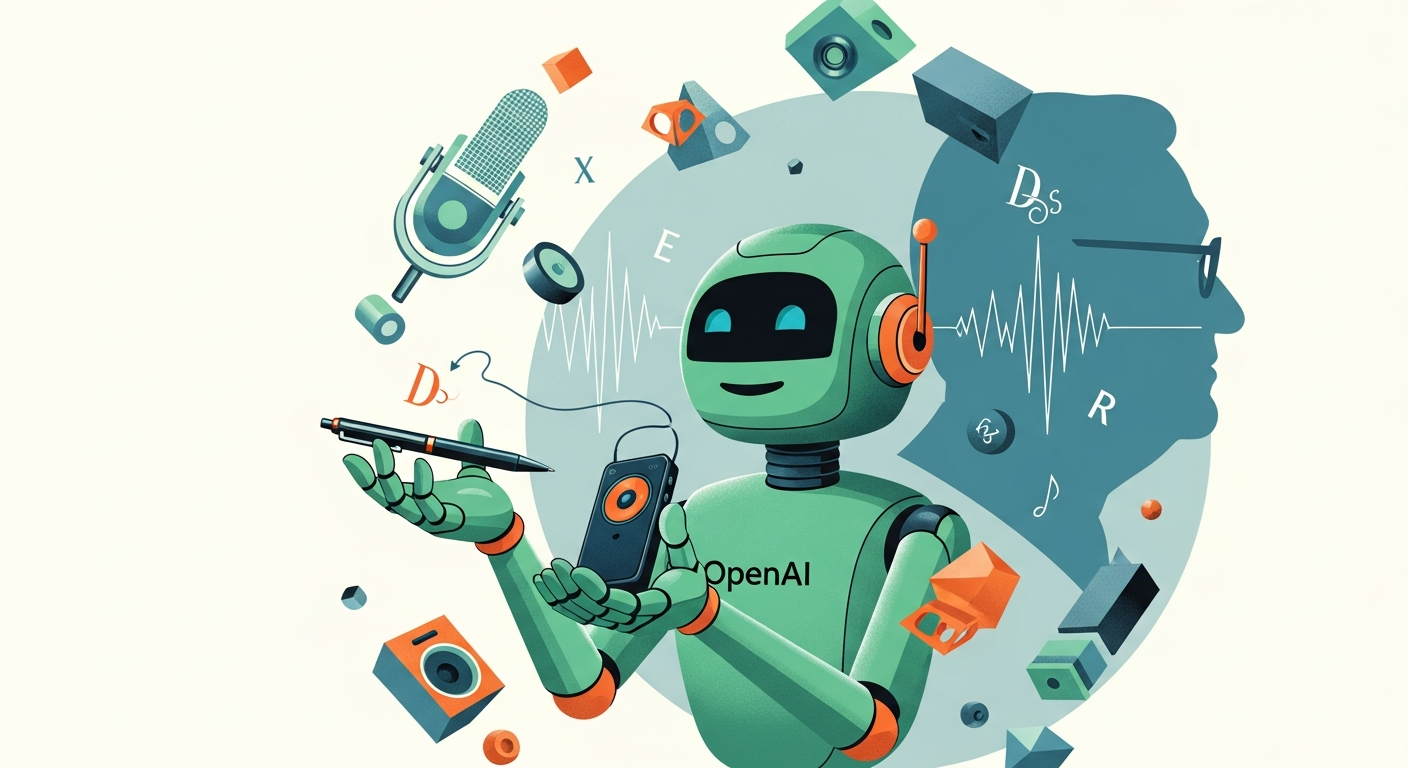
OpenAI is making a dramatic hardware pivot, reorganizing entire teams to launch screenless, voice-first AI devices within a year.
They're developing an AI-powered pen codenamed "Gumdrop" and a separate portable audio device.
DeepSeek just published a paper on their new training method called Manifold-Constrained Hyper-Connections, or mCH.
This framework promises to drastically reduce the computational and energy demands for training frontier AI models, which could be a game-changer for efficiency.
Waymo is grabbing market share at an incredible pace, Tesla's Cybercab is expected to launch this year with aggressive pricing, and Uber is caught in the middle trying to figure out its strategy.
And in a sign of AI's growing impact, the UK accounting organization ACCA is halting remote exams starting March 2026 because AI-assisted cheating has become impossible to police.
DEEP DIVE ANALYSIS: OPENAI'S AUDIO-FIRST HARDWARE PIVOT
Technical Deep Dive
OpenAI is making its biggest bet yet on audio-first interfaces, completely overhauling its approach to AI hardware. The company has unified multiple engineering, product, and research teams to rebuild its audio AI architecture from the ground up. They're developing two primary devices: an AI-powered pen called "Gumdrop" that transcribes handwritten notes directly to ChatGPT while enabling voice conversations, and a separate portable audio device designed as a voice-first AI companion.
This isn't just a software update. OpenAI acquired Jony Ive's hardware startup io for approximately $6.5 billion back in May 2025, bringing 55 engineers and the legendary designer behind the iPhone into the fold.
Manufacturing will be handled by Foxconn in Vietnam, notably avoiding Chinese manufacturers. The technical breakthrough centers on a new audio model architecture launching in Q1 2026, led by researcher Kundan Kumar, recruited specifically from Character.AI.
This new system addresses current limitations head-on: more natural speech patterns without robotic pauses, faster response times to match text-based models, real-time interruption handling so you can cut the AI off mid-sentence like a natural conversation, and accuracy matching text-based performance. The architecture represents a fundamental rethinking of how AI processes and generates audio, moving beyond the current paradigm where audio capabilities lag significantly behind text.
Financial Analysis
The $6.5 billion acquisition of Jony Ive's io represents one of OpenAI's largest strategic investments, signaling serious commitment to hardware as a revenue stream. This move diversifies OpenAI's business model beyond API access and ChatGPT subscriptions, potentially opening massive consumer hardware markets.
The financial logic is compelling. Smart speakers have already penetrated over a third of U.S.
homes, proving consumers will adopt voice-first devices. OpenAI is positioning these products not as phone replacements—which would compete directly with Apple and Google—but as complementary "third core devices" alongside laptops and phones. This strategy reduces competitive friction while expanding total addressable market.
The timing aligns with OpenAI's reported path toward profitability. Hardware sales provide immediate revenue recognition, unlike subscription models that recognize revenue over time. Premium pricing justified by Ive's design pedigree could deliver significant margins.
Consider AirPods, which command premium prices despite commodity components inside. Manufacturing in Vietnam rather than China has cost implications but reduces geopolitical risk and may appeal to enterprise customers concerned about data sovereignty. The decision reflects lessons from hardware startups like Humane and Rabbit, which burned hundreds of millions on failed products.
OpenAI is taking the opposite approach: investing heavily upfront in design, engineering, and manufacturing partnerships to ensure quality execution.
Market Disruption
This move directly challenges the entire smart device ecosystem. Apple's AirPods and Siri integration, Amazon's Echo devices, Google's Nest Audio, and Meta's Ray-Ban smart glasses all suddenly face competition from a company with the most advanced conversational AI on the planet. The disruption pattern is fascinating.
Previous attempts at screenless AI devices—Humane's AI Pin and Rabbit R1—flopped spectacularly because they tried to replace phones entirely. OpenAI learned from these failures. By focusing on specific use cases like note-taking and voice interaction rather than being a phone replacement, they're creating a new category instead of competing in an established one.
Waymo's success in ridesharing provides an instructive parallel. Waymo isn't cheaper than Uber, yet it's rapidly gaining market share because people simply prefer riding without a driver. Similarly, OpenAI is betting that people will prefer interacting without a screen for many tasks, even if it's not objectively "better" in all scenarios.
The implications for existing players are severe. If OpenAI cracks audio-first interfaces, companies like Amazon and Google must respond with equivalent AI capabilities or risk irrelevance. Apple's Siri, long criticized for underperformance, becomes an even bigger liability.
Meta's investment in Ray-Ban smart glasses gains new urgency as the audio-first race accelerates.
Cultural & Social Impact
OpenAI's hardware push represents something bigger than product launches—it's a fundamental rethinking of how humans interact with technology. We've spent decades glued to screens, and that's taken a documented toll on mental health, attention spans, and social connection. Audio-first interfaces promise a more natural, less intrusive way to access AI assistance.
The pen device particularly targets knowledge workers drowning in note-taking and documentation. Imagine meetings where you write naturally while an AI captures, structures, and makes your notes searchable and actionable. The cognitive load reduction could be transformative for productivity and creativity.
But there are darker implications. These devices will constantly listen, raising surveillance concerns. OpenAI's deliberate choice to avoid Chinese manufacturers suggests awareness of these issues, but questions remain about data handling and privacy.
The Friend AI pendant already records your life continuously—do we want that capability controlled by a single company? There's also the human displacement angle. If voice AI becomes truly natural and capable, entire categories of voice-based work—customer service, phone support, appointment scheduling—face automation pressure.
The social fabric changes when AI intermediaries handle many routine human interactions. The broader cultural shift toward "ambient AI" is already underway. Meta's Ray-Ban glasses with five-microphone arrays for enhanced hearing.
Tesla integrating conversational AI into vehicles. Google transforming search results into audio summaries. OpenAI's devices accelerate a trend where AI becomes environmental rather than application-based—always present, always listening, always ready to assist.
Executive Action Plan
First, technology executives must immediately pilot voice-first interfaces within their organizations. Don't wait for perfect products. Identify specific use cases where screen-free interaction delivers clear value: field service documentation, warehouse operations, medical rounds, or executive note-taking.
Run structured experiments with available tools like advanced voice mode in ChatGPT or existing smart speaker integrations. Measure actual productivity gains versus user satisfaction. The companies that master voice-first workflows before hardware arrives will have massive advantages in adoption and change management.
Second, product leaders should audit their current interfaces for voice-readiness. Most software is designed screen-first with voice as an afterthought. That's backwards in an audio-first future.
Start redesigning core workflows to be voice-native. This means rethinking information architecture, confirmation patterns, error handling, and navigation completely. The winners will be products that feel natural to use through conversation, not voice-controlled versions of visual interfaces.
Third, enterprise buyers need to establish vendor evaluation frameworks for voice AI now. Key criteria should include: audio processing latency, interruption handling capability, context retention across conversations, privacy and data handling, integration capabilities with existing systems, and offline functionality. Don't assume all voice AI is equivalent—there will be massive quality differences.
OpenAI's technical approach suggests industry-leading capabilities, but evaluate actual performance rigorously. The procurement decisions you make in 2026 will determine your organization's AI-readiness for years to come.
Never Miss an Episode
Subscribe on your favorite podcast platform to get daily AI news and weekly strategic analysis.