Physical Intelligence's Robot Olympics Signals Foundation Models Work in Physical Space
Episode Summary
TOP NEWS HEADLINES Physical Intelligence just threw down the gauntlet with their Robot Olympics, putting their π0. 6 model through the kind of tasks we've all been demanding robots actually do. We...
Full Transcript
TOP NEWS HEADLINES
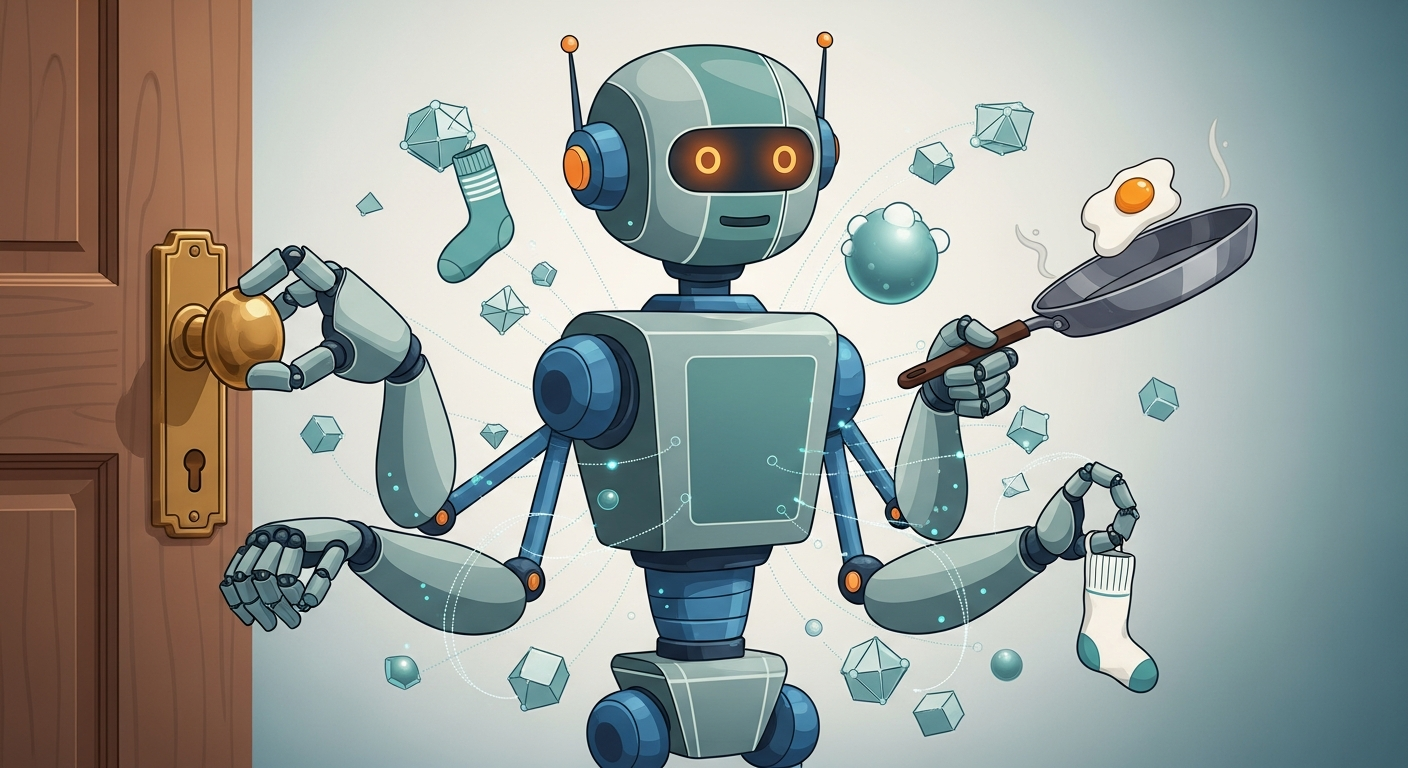
Physical Intelligence just threw down the gauntlet with their Robot Olympics, putting their π0.6 model through the kind of tasks we've all been demanding robots actually do.
We're talking opening doors, turning socks right-side out, putting keys in locks, and yes, washing a greasy frying pan.
These aren't cherry-picked demos, they're systematic benchmarks with honest scorecards showing exactly where current robotics stands with household tasks.
Google rolled out Data Tables that transform messy sources into structured information ready for Google Sheets export, and they're testing a Lecture format that generates comprehensive 30-minute audio deep dives in multiple languages.
This shifts NotebookLM from simple summarization into serious knowledge synthesis.
Microsoft announced they want to eliminate every line of C and C++ code from their entire codebase by 2030.
They're hiring engineers to build tools that combine AI and algorithms to rewrite millions of lines of code at scale.
One engineer, one month, one million lines of code translated to Rust.
Salesforce quietly added 6,000 enterprise AI customers in a single quarter, pushing their Agentforce platform past 18,500 customers and over 540 million dollars in agentic AI annual recurring revenue.
While everyone debates whether there's an AI bubble, enterprise adoption is accelerating faster than most people realize.
Stanford researchers are calling 2026 the year AI faces reality.
No more selling possibility, time to answer for actual results.
They're seeing governments push AI sovereignty through local compute, enterprises admitting most deployments failed outside narrow use cases, and model progress slowing as teams shift to smaller systems trained on curated datasets.
DEEP DIVE ANALYSIS: PHYSICAL INTELLIGENCE'S ROBOT OLYMPICS AND THE FOUNDATION MODEL MOMENT FOR ROBOTICS TECHNICAL DEEP DIVE What Physical Intelligence just demonstrated represents a fundamental shift in how we approach robotics.
Their π0.6 model is what they call a vision-language-action policy, essentially an LLM for robots where visual input plus instructions translate directly into motor actions.
The breakthrough isn't just that the robot can perform these tasks, it's *how* it learned them.
Traditional robotics required bespoke solutions for every single task.
You'd spend months programming a robot to open one specific type of door.
Physical Intelligence is proving the foundation model approach works for physical systems.
They pretrain on diverse robot experiences, creating representations that generalize across tasks.
Then they fine-tune for specific scenarios using surprisingly little additional data.
The technical innovation that really matters here is their human-to-robot transfer work.
They're showing that once you pretrain these vision-language-action models on enough robot data, the representation space starts aligning human egocentric video with robot behavior.
This means you can teach robots from cheap human footage rather than expensive robot training time.
In their latest paper, they report roughly two-times improvements on human-only generalization tasks when adding human video during fine-tuning.
That's not just incremental, it suggests the next major data source for training robots might be humans living their normal lives on camera.
The contact-rich manipulation they're demonstrating, washing pans, handling deformable materials like plastic bags that blind wrist cameras, turning socks inside out, these are the problems that have frustrated robotics researchers for decades.
The fact that one generalist model can handle this range of tasks autonomously, decomposing problems and recovering from failures without human intervention between attempts, that's the signal that foundation models are starting to work in physical space the way they worked for language.
FINANCIAL ANALYSIS The investment implications here are stark and immediate.
Physical Intelligence isn't publicly traded yet, but they've raised significant capital from top-tier investors who understand that whoever cracks general-purpose robotics captures a market measured in trillions, not billions.
The total addressable market for robotic systems that can actually perform useful household and commercial tasks is essentially the entire labor market for physical work.
Compare the capital efficiency of this approach to traditional robotics companies.
Boston Dynamics spent decades and hundreds of millions of dollars building impressive robots that still can't reliably perform useful economic tasks.
Physical Intelligence is demonstrating practical capabilities after relatively modest training investments by leveraging the foundation model scaling laws that worked for language.
The business model becomes viable when you can deploy one platform across thousands of tasks rather than engineering custom solutions.
If fine-tuning for a new task costs tens of thousands instead of millions, and you can use human demonstration data instead of expensive robot training time, the unit economics shift dramatically.
You're looking at potential gross margins similar to software once the initial model is trained.
Tesla's Optimus program has similar ambitions, backed by nearly unlimited capital and manufacturing expertise.
But they're pursuing a hardware-first approach while Physical Intelligence is proving the software and learning systems can advance faster.
The question for investors is whether this becomes a winner-take-most market where the best foundation model captures exponential returns, or whether multiple specialized players coexist serving different segments.
Wall Street hasn't fully priced in what happens when physical labor becomes software-scalable.
The robotics companies that demonstrate reliable commercial deployments in the next eighteen months will see step-function valuation increases.
Physical Intelligence just moved significantly closer to proving their approach works.
MARKET DISRUPTION Every company building products or services that depend on physical manipulation should be gaming out this scenario right now.
The Robot Olympics benchmark Physical Intelligence published isn't just a research demo, it's a roadmap showing which tasks are becoming automatable and how fast the capabilities are advancing.
Warehouse automation companies like Amazon Robotics have been focused on structured environments with predictable objects.
Physical Intelligence is showing that unstructured manipulation, the kind required in homes, restaurants, and small businesses, is approaching viability.
That dramatically expands the addressable market beyond logistics into essentially every physical space.
The hospitality industry faces particularly acute disruption.
Restaurant chains struggling with labor costs and consistency could deploy these systems for food prep and cleaning within three to five years if the reliability curve continues.
Fast food franchises already operate in semi-structured environments that play to these systems' strengths.
The first major chain to successfully deploy kitchen automation gains a sustained competitive advantage.
Patient care involves endless contact-rich manipulation tasks.
If these foundation models can be fine-tuned for medical environments, you could automate significant portions of routine nursing tasks, addressing the massive shortage of healthcare workers while improving consistency.
The regulatory path is longer, but the economic pressure is enormous.
The competitive dynamic between specialized robotics companies and foundation model companies will define the next decade.
Companies like iRobot built single-purpose robots for vacuuming.
Physical Intelligence suggests we're moving toward general-purpose platforms that can be adapted to hundreds of tasks.
That's an existential threat to vertical robotics players who can't match the data scale and model sophistication of well-funded foundation model companies.
Legacy automation vendors that sell expensive custom robotics solutions to factories and warehouses face margin compression as customers realize they can buy adaptable platforms and fine-tune them internally.
The professional services revenue that sustained robotics integrators evaporates when deployment becomes a software configuration problem rather than a mechanical engineering project.
CULTURAL AND SOCIAL IMPACT We need to talk honestly about what happens when household robots actually work.
The social implications of Physical Intelligence's demonstration extend far beyond technology circles.
When robots can reliably perform the tasks shown in the Robot Olympics, we're talking about automating significant portions of domestic labor that currently falls disproportionately on women and lower-income workers.
The first-order effect is liberation for many people.
If you're a working parent spending fifteen hours per week on cooking, cleaning, and laundry, getting that time back is life-changing.
Domestic work and caregiving employ tens of millions of people globally, many of whom have limited alternative employment options.
The transition could be brutal without serious policy intervention.
The cultural narrative around work and productivity shifts fundamentally.
We've spent two centuries building social systems around the assumption that physical labor provides essential employment.
When that assumption breaks, society needs new frameworks for distributing resources and meaning.
Universal basic income discussions move from theoretical to urgent.
There's also something deeply weird about inviting machines that can manipulate physical objects into our most intimate spaces.
These systems require cameras and sensors throughout your home to navigate and perform tasks.
How do we prevent it from being monetized or weaponized?
The smart speaker privacy debates will look quaint compared to robots that observe everything you do.
For elderly people and those with disabilities, reliable household robots represent genuine independence and dignity.
But if these systems are expensive luxury goods initially, they could deepen inequality, creating a world where wealthy households have automated support while everyone else still does manual labor.
EXECUTIVE ACTION PLAN If you're a business leader, here are specific actions to take in the next quarter based on Physical Intelligence's demonstration of viable general-purpose robotics. **First, audit your physical workflows for automation opportunities.** Don't wait for perfect robots.
Identify the repetitive manipulation tasks in your operations that involve contact-rich interactions, deformable materials, or navigation through semi-structured spaces.
These are the capabilities Physical Intelligence just proved are approaching reliability.
Manufacturing operations, warehouse fulfillment, food service, and facilities maintenance all contain tasks that map directly to the Robot Olympics benchmarks.
Build an internal roadmap showing which processes become automatable as these capabilities mature over the next twelve to thirty-six months.
The companies that plan proactively will move faster than competitors who wait for off-the-shelf solutions. **Second, start collecting task demonstration data now.** The human-to-robot transfer breakthrough means your existing training videos and process documentation might become valuable robot training data.
If you operate restaurants, start recording detailed first-person video of your best employees performing key tasks.
If you run warehouses, document how experienced workers handle edge cases and unusual packages.
The foundation model companies will need domain-specific data to fine-tune their systems, and you can either provide that data as a customer or sell it as a strategic asset.
Either way, the data you collect now shortens your deployment timeline later. **Third, engage with the robotics foundation model ecosystem immediately.** Physical Intelligence, Tesla, and several stealth competitors are all racing to build the Android or iOS of robotics.
These platforms will need launch partners for real-world testing and validation.
If you operate at scale in physical industries, you should be in conversations with these companies about pilot programs and strategic partnerships.
The first movers who shape these platforms around their workflow requirements will have sustained advantages over competitors who adopt generic solutions later.
Reach out to Physical Intelligence directly, attend their demos, and make it clear you're serious about deployment timelines and volume commitments.
The companies that treat this as science fiction will be disrupted by competitors who treat it as inevitable.
Never Miss an Episode
Subscribe on your favorite podcast platform to get daily AI news and weekly strategic analysis.