Google's Gemini 3 Pro Topples OpenAI, Reshapes AI Competition
Episode Summary
Your daily AI newsletter summary for November 21, 2025
Full Transcript
TOP NEWS HEADLINES
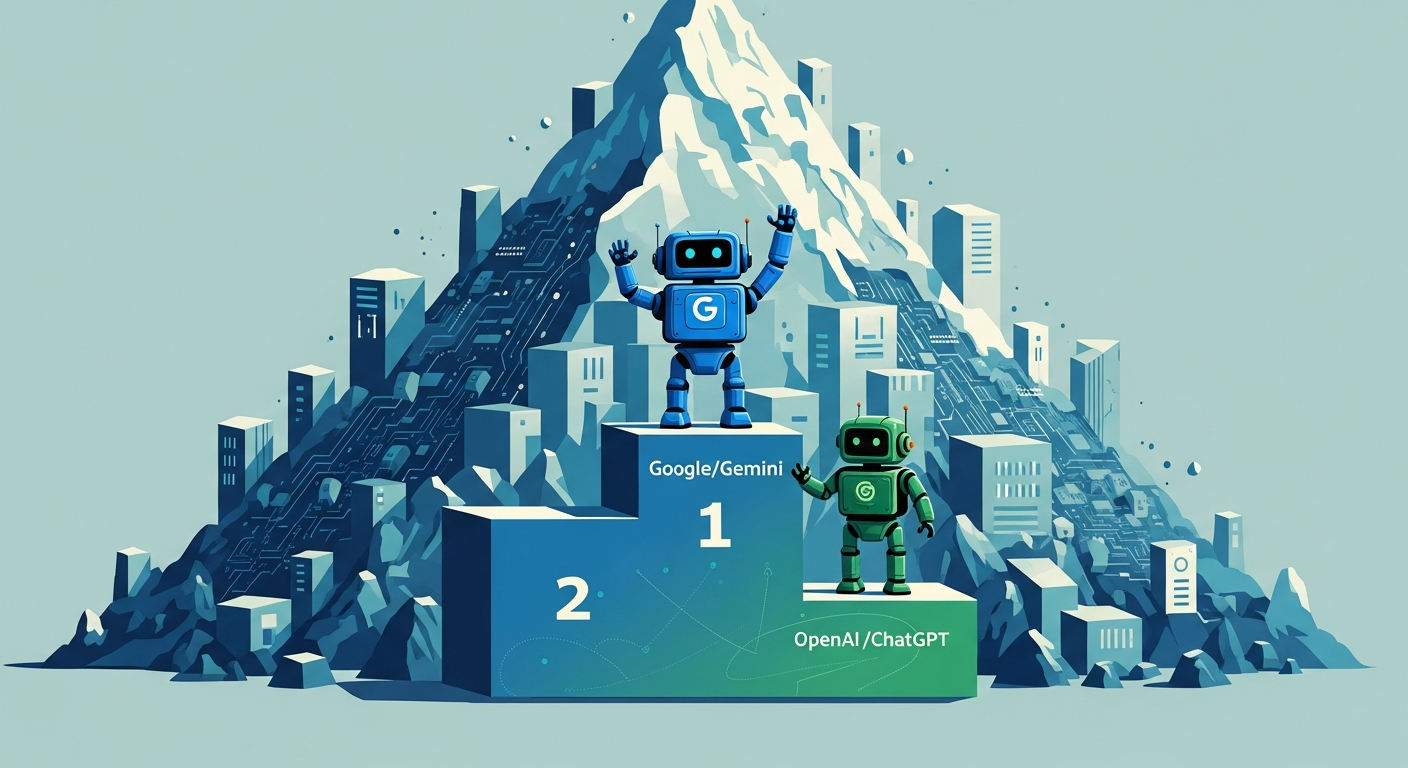
Google just dropped Gemini 3 Pro and it's officially topped the leaderboard as the world's number one AI model, beating OpenAI's latest offerings on key benchmarks.
This isn't just an incremental improvement—we're talking about a significant leap in reasoning, coding, and multimodal capabilities.
They released Nano Banana Pro, their next-generation image model that can finally nail text rendering, handle complex infographics, and maintain character consistency across multiple images.
This thing pulls data directly from Google Search for world knowledge integration.
OpenAI responded by rolling out group chats in ChatGPT globally to all subscription tiers, allowing up to 20 people to collaborate with the AI simultaneously.
They're also testing a new model internally nicknamed "Shallotpeat" that's supposedly a Gemini-killer.
In the open-source world, AI2 released OLMo 3, the first fully transparent reasoning model where you can see every training checkpoint, every dataset decision, every line of code.
This is unprecedented transparency in AI development.
And in a wild move, crypto exchange Bitrue just connected multiple frontier AI models—GPT-5, Gemini, Claude, Grok—directly to its trading engine, letting them execute real trades autonomously.
DEEP DIVE ANALYSIS
Let's dive deep into what I think is the most significant story this week: Google's Gemini 3 Pro release and what it means for the entire AI landscape.
Technical Deep Dive
Gemini 3 Pro represents something we haven't seen in over a year—definitive proof that pre-training scaling laws are still intact. The model has the same parameter count as Gemini 2.5 but shows massive performance improvements, with Google crediting this to advances in both pre-training and post-training techniques.
What's particularly interesting is the coherent FLOPs argument. Even though Gemini 3 was trained on TPUs rather than Nvidia's GPUs, the compute efficiency should transfer directly to Blackwell chips. This means when we see GPT-5 and other next-generation models trained on Blackwell hardware next year, we should expect similar leaps in capability.
The model excels across the board—advanced reasoning, agentic coding, and multimodal generation. But it's the Nano Banana Pro image component that really showcases what happens when you integrate world-class reasoning with generation. The ability to pull real-world knowledge from Google Search into image creation fundamentally changes what's possible.
We're not just generating pretty pictures anymore; we're creating accurate infographics, historically correct scenes, and data visualizations that actually mean something.
Financial Analysis
The financial implications here are staggering. Nvidia just posted 57 billion dollars in quarterly revenue, with 61 percent coming from just four customers—primarily neoclouds like CoreWeave, Nebius, and Lambda. These companies are buying GPUs in bulk, repackaging compute, and renting it back to the ecosystem.
Nvidia itself spent 26 billion dollars this quarter renting GPUs from these partners to run DGX Cloud. Here's where Gemini 3's efficiency matters: the model demonstrates that you can achieve frontier performance with smarter training, not just bigger clusters. For cloud providers and enterprises, this means the compute arms race might be entering a new phase where algorithmic efficiency matters as much as raw hardware.
Google's integration strategy also has massive financial upside. By embedding Gemini 3 and Nano Banana Pro across Search, Workspace, and their entire product ecosystem, they're not just selling API access—they're locking users into an integrated experience that's nearly impossible to replicate. OpenAI can't compete with this distribution advantage, no matter how good their models are.
The market clearly agrees. Alphabet's stock jumped 4 percent on the Nano Banana Pro announcement alone, following the Gemini 3 release earlier in the week. Meanwhile, the pressure is mounting on independent players like Midjourney and Ideogram, who lack the platform integration and compute resources to keep pace.
Market Disruption
This release fundamentally reshapes the competitive landscape. OpenAI has been the mindshare leader for two years, but they're stuck in what one analyst called "the chatbot paradigm." Their recent launches haven't gained traction, and there's a reason: they don't control distribution.
Google's advantage isn't just better models—it's that Gemini 3 flows through Search, Gmail, Docs, Meet, and every other touchpoint where billions of people already work. Those "little advantages" from their wide variety of apps compound rapidly. When you're researching something and Gemini can pull context from your email, calendar, and documents while generating accurate visualizations, that's not a feature—that's a moat.
The image generation war just went from interesting to decisive. Midjourney built a community around diffusion models and artistic quality. But when Google ships studio-quality image generation with perfect text rendering and world knowledge directly into products people already use daily, the indie players face an existential question: what's your sustainable competitive advantage?
Meta's SAM 3 and SAM 3D releases show they understand this shift too. The era of standalone AI tools is ending. The future belongs to integrated AI ecosystems, and only a handful of companies have the infrastructure to compete.
Cultural and Social Impact
We're witnessing a fundamental shift in how people interact with creative tools. The viral Nano Banana trend in August turned selfies into 3D figurines, showing mainstream appetite for AI creativity. Now with Pro, we're moving beyond novelty to utility.
The ability to create accurate infographics from code snippets or LinkedIn resumes, to visualize data in ways that were previously impossible without design skills—this democratizes communication. The marketing professional who couldn't afford a designer can now create professional lead magnets. The teacher can generate educational materials with accurate historical scenes.
The small business owner can produce visual content that previously required an agency. But there's a darker side. ChatGPT's group chat feature, while collaborative, also signals AI becoming an invisible participant in team dynamics.
When AI interjects in conversations, gauging flow and contributing ideas, we're training ourselves to view machine intelligence as a peer rather than a tool. The psychological implications of this shift haven't been fully explored. The Bitrue trading desk connected to multiple AI models represents something more concerning: the moment when AI agents begin competing against humans in consequential, real-money scenarios.
This isn't simulation anymore. When algorithms battle for milliseconds and strategy dominance in financial markets, retail traders aren't just competing with other humans—they're competing with entities that never sleep, never experience fear or greed, and process information at inhuman speeds.
Executive Action Plan
First, if you're leading product or engineering teams, you need to reassess your AI strategy immediately. The scaling laws debate is over—bigger, smarter models are coming, and they're coming fast. Plan your infrastructure and capabilities around the assumption that next year's models will be significantly more capable than today's.
This means investing in the integration layer now, not the model access. Your competitive advantage won't be which API you call; it'll be how deeply you integrate AI into your user experience and workflow. Second, for creative and marketing leaders, it's time to experiment with integrated AI tools, not standalone ones.
The Nano Banana Pro capabilities around infographic creation and visual communication represent a fundamental shift. Test how these tools can accelerate your team's output. The companies that figure out how to augment human creativity with AI-generated visuals will ship content at speeds and scales that competitors can't match.
Start small—use it for internal presentations, lead magnets, social media assets—and build competency before your competitors do. Third, and this is critical: if you're in a business that relies on proprietary AI models or specialized tools, you need a hard conversation about your defensibility. Google just demonstrated that platform players with distribution and compute can iterate faster than anyone expected.
Your model might be better today, but can you maintain that advantage when tech giants ship comparable capabilities directly into products with billions of users? If the answer isn't a confident yes, you need to pivot toward unique data, specialized workflows, or vertical integration that can't be commoditized by better foundation models.
Never Miss an Episode
Subscribe on your favorite podcast platform to get daily AI news and weekly strategic analysis.