Google's Gemini 3 Reclaims AI Leadership from OpenAI
Episode Summary
Your daily AI newsletter summary for November 20, 2025
Full Transcript
TOP NEWS HEADLINES
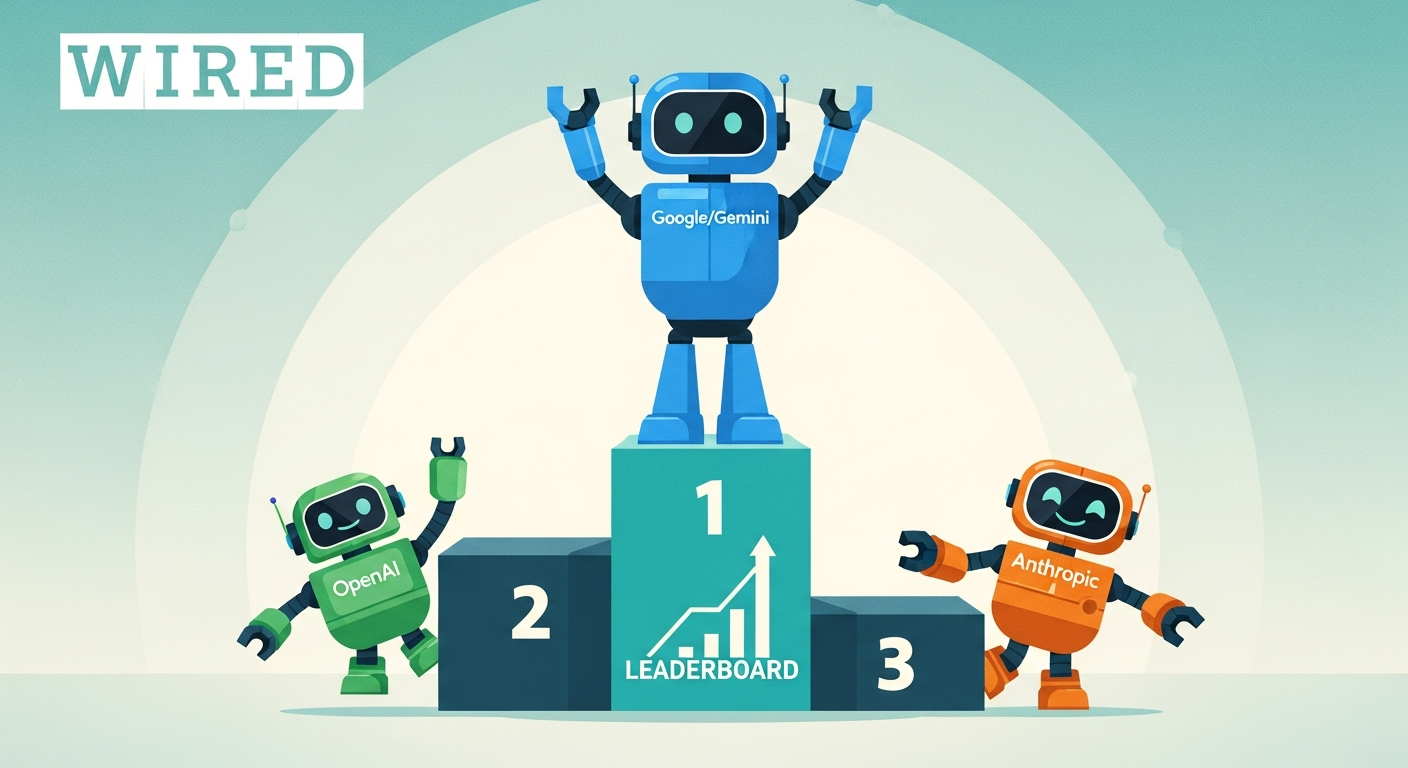
Google just dropped Gemini 3, and it's absolutely dominating the leaderboards right now.
We're talking 1501 Elo on LMArena, crushing benchmarks in reasoning, coding, and multimodal tasks—this is Google finally taking back the crown from OpenAI after months of playing catch-up.
Microsoft and Nvidia are throwing massive money at Anthropic—we're talking a combined dollar 15 billion investment that values Claude's parent company at around dollar 350 billion.
Anthropic's committing to dollar 30 billion in Azure compute and another gigawatt of Nvidia capacity, making this one of the biggest AI infrastructure deals we've seen.
Voice interfaces are having their moment, and it's not just hype anymore.
Between Apple's LLM-powered Siri coming in 2026, Meta's Ray-Ban smart glasses with neural bands, and Microsoft pushing voice-first experiences across Office 365, we're looking at a fundamental shift in how we interact with AI—typing might actually become optional sooner than we think.
Cloudflare had a catastrophic outage yesterday that took down roughly 20 percent of the internet, including ChatGPT, Claude, and Spotify.
It's a brutal reminder that while we're obsessing over AI safety, the real systemic risk might be sitting in the infrastructure layer that nobody's really regulating.
Tesla finally opened up their Full Self-Driving data after Waymo called for transparency, showing 5 million miles per major crash.
The numbers look impressive, but regulators aren't quite ready to sign off on an AI-driven system that learns behavior rather than following hard-coded rules.
DEEP DIVE ANALYSIS
Let's talk about what Google's Gemini 3 launch really means, because this isn't just another model release—this is a complete reset of the competitive landscape in AI.
Technical Deep Dive
Gemini 3 represents something fundamentally different from what we've seen before. Google spent two years building this as a truly unified multimodal model, trained end-to-end on their proprietary TPU infrastructure. That matters more than you might think.
While OpenAI and Anthropic have been iterating on transformer architectures and bolting on multimodal capabilities, Google went back to first principles. The model isn't just good at multiple things—it thinks natively across text, vision, audio, and code simultaneously. That 91.
9 percent score on GPQA Diamond isn't just a benchmark win; it demonstrates genuine scientific reasoning capability. The ARC-AGI-2 scores show improved abstract reasoning. And that 1501 Elo on LMArena?
That's the first time we've seen a model definitively surpass GPT-5 in head-to-head comparisons chosen by humans. But here's what's really interesting: they launched it alongside Antigravity, their new agentic IDE. This isn't just a model—it's a complete development platform with browser control, asynchronous workflows, and multi-agent orchestration built in from day one.
Google's betting that the model layer and the tooling layer need to evolve together, and they might be right. The Deep Think mode is particularly noteworthy. It's not just letting the model run longer—it's a fundamentally different inference pattern that shows the same breakthrough we saw with OpenAI's o1, but integrated into a production model that also excels at fast, low-latency tasks.
Financial Analysis
The economics here are fascinating and a bit terrifying for Google's competitors. Google's dumping this capability into products that reach 2 billion users through AI Overviews and 650 million through the Gemini app. They're not charging separately for most of this access—they're embedding intelligence into their existing ecosystem.
That's a very different financial model than OpenAI's subscription approach or Anthropic's API-first strategy. Google can afford to give away Gemini 3 capability because they're monetizing through search advertising, cloud compute sales, and Workspace subscriptions. When Demis Hassabis talks about bringing AI to healthcare and education through Android, he's talking about reaching billions of users in emerging markets where nobody else can compete on distribution.
The cloud infrastructure play is equally important. Google Cloud customers get native Gemini 3 access, and unlike Azure's marketplace approach where you're effectively renting someone else's model, this is Google's own technology optimized for their own hardware. The margin structure is completely different.
But there's a cost concern nobody's talking about publicly: training Gemini 3 on TPUs required massive capital investment in custom silicon. Google's AI infrastructure spending is substantial, and while they're not breaking it out separately, we can infer from their capex numbers that they're spending tens of billions on this buildout. They're betting that vertical integration—controlling the silicon, the model training, and the application layer—will create sustainable economic advantages.
Market Disruption
This launch fundamentally changes the competitive dynamics in three ways. First, it breaks OpenAI's technical leadership position that they've held since GPT-4. That matters psychologically in the market.
Enterprises that were defaulting to OpenAI now have a credible alternative with better benchmark performance and deeper integration into tools they already use. Second, it puts enormous pressure on Anthropic. Claude's been positioning itself as the thoughtful, safety-conscious alternative, but when Gemini 3 matches or exceeds Claude's performance while being available in more places at potentially lower cost, that's a problem.
The fact that both Elon Musk and Sam Altman publicly congratulated Google tells you how significant this shift is—they recognize the threat. Third, it completely changes the equation for enterprises building AI strategies. Six months ago, you built on OpenAI and maybe hedged with Anthropic.
Now you have to consider whether Google's integrated approach—where the same model powers your search, your workspace productivity, your cloud applications, and your custom development—creates better total cost of ownership than assembling best-of-breed components. The developer ecosystem impact is particularly important. Google's been playing catch-up in AI developer mindshare, but Antigravity could change that.
If developers start building agentic applications on Google's platform because it has the best integrated tooling, that creates a moat that's hard to overcome with model quality alone.
Cultural and Social Impact
We're watching a shift from AI as a separate tool to AI as ambient infrastructure, and Gemini 3 accelerates that transition. When Google integrates this level of intelligence into Search, Maps, Photos, and Gmail—products that billions of people use daily without thinking—AI stops being something you "use" and becomes something that's just... there.
That's both powerful and concerning. The medical diagnostic capabilities Demis mentioned could genuinely save lives in underserved areas. An AI with Gemini 3's multimodal reasoning, available through a dollar 200 Android phone, could provide primary care guidance to people who've never had access to a doctor.
That's transformative. But it also means Google's AI is making decisions about what information billions of people see, how their productivity tools work, what medical advice they receive—all through a black box model that's constantly learning and adapting. We're not having serious regulatory conversations about this yet, and we should be.
The voice interface timing is particularly interesting. Google's launching Gemini 3 just as voice is becoming the primary AI interface. That's not a coincidence.
Multimodal models that can understand context from your camera, your location, your calendar, and your voice simultaneously are fundamentally more useful than text-only chat interfaces. Google's betting that the future of AI interaction isn't opening ChatGPT on your phone—it's talking to AI that's embedded in your glasses, your earbuds, or your watch.
Executive Action Plan
If you're a technology executive, here's what you need to do this week—not next quarter, this week: First, audit your AI dependencies immediately. If your product strategy assumes OpenAI maintains technical leadership, that assumption just became invalid. You need to actually test Gemini 3 against your current AI providers on your specific use cases.
Not benchmarks—your actual workloads. If you're spending millions on OpenAI API calls and Gemini 3 delivers equivalent or better results at lower cost with better integration into Google Cloud services you're already using, you have a fiduciary responsibility to evaluate that. Set up parallel testing this week.
Second, reconsider your build-versus-buy decisions around AI tooling. If you've been building custom agent frameworks, workflow orchestration, or development tools, Antigravity just made some of that investment obsolete. Google's giving away for free what many companies spent millions building internally.
You need to honestly assess whether your proprietary AI infrastructure actually creates competitive advantage or whether you should sunset it and build on Google's platform instead. This is painful because it means writing off recent investments, but continuing to pour resources into custom infrastructure that Google's commoditizing is worse. Third, start planning for voice-first interfaces now.
The convergence of voice AI, multimodal understanding, and ambient computing isn't five years away—it's happening in product cycles starting next year. If your product strategy still assumes keyboard and screen as primary interfaces, you're designing for the past. Start prototyping voice-first experiences immediately, even if they're just internal experiments.
The companies that figure out conversational AI interfaces in 2025 will have years of user experience advantage over competitors who wait until 2026. The broader strategic implication is this: we just moved from a world where you could reasonably build an AI strategy around one primary model provider to a world where Google, OpenAI, and Anthropic all have legitimate technical leadership in different dimensions. That means your AI strategy needs to be multi-provider by default, with abstraction layers that let you swap models based on task, cost, and performance.
If you haven't built that flexibility into your architecture, you're about to have a very expensive re-architecture project.
Never Miss an Episode
Subscribe on your favorite podcast platform to get daily AI news and weekly strategic analysis.