China's Kimi K2 Disrupts AI Market with Frontier Performance at Fraction of Cost
Episode Summary
Your daily AI newsletter summary for November 08, 2025
Full Transcript
TOP NEWS HEADLINES
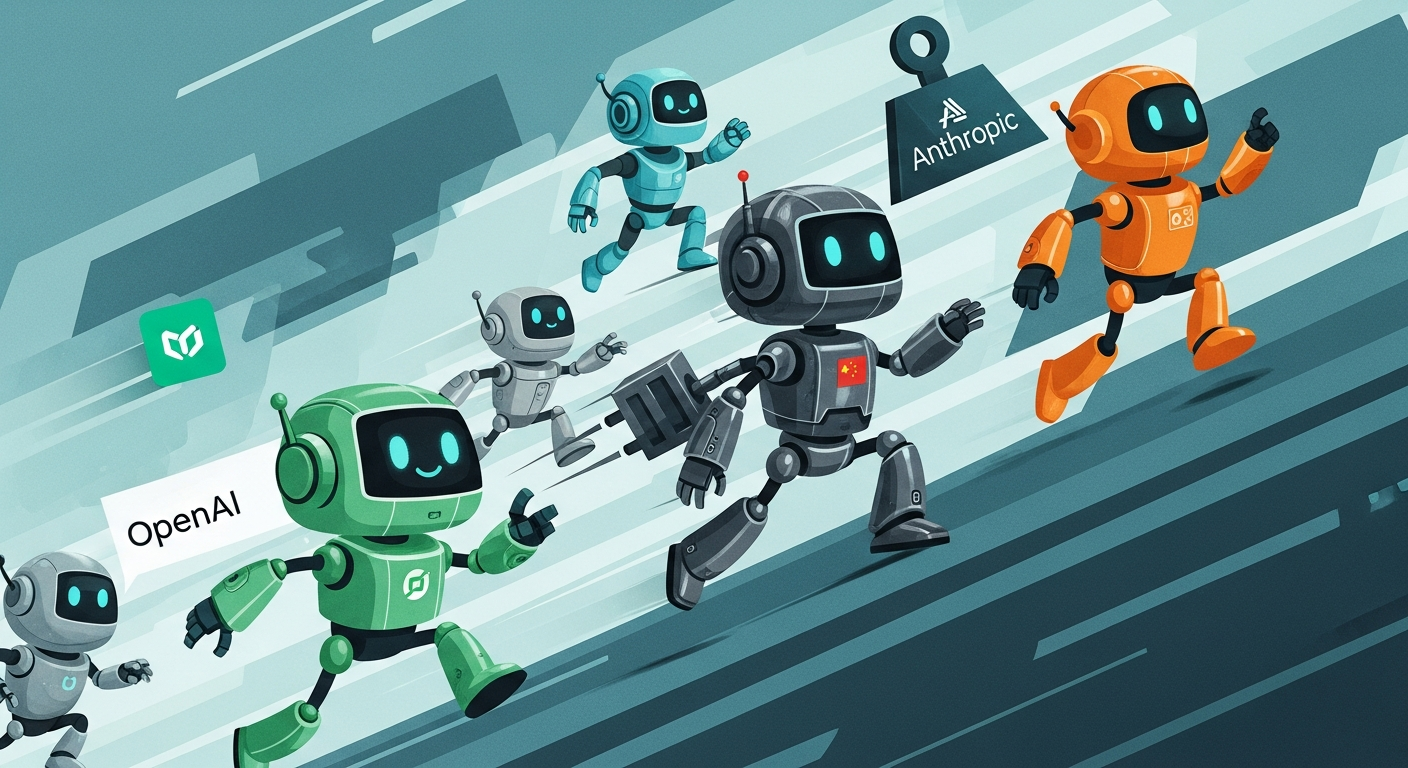
China's Moonshot AI just dropped a bomb on the AI world with their Kimi K2 Thinking model - it's open source, matches GPT-5 performance on several benchmarks, and costs six times less to run.
Jensen Huang's comment about China being "nanoseconds behind" in AI suddenly looks prophetic.
OpenAI had a messy week dealing with what's being called "backstopgate" - their CFO Sarah Friar walked back comments about wanting federal guarantees for infrastructure spending after massive backlash, with Sam Altman clarifying they don't want bailouts for private AI firms.
Microsoft is making a major play for independence from OpenAI by launching their own Superintelligence Team under Mustafa Suleyman, focusing on what they're calling "Humanist Superintelligence" - AI that solves specific problems like medicine and energy rather than chasing open-ended AGI.
Google is reportedly in talks to deepen their investment in Anthropic at a staggering 350 billion dollar valuation, which would make it one of the most valuable AI startups in history - this comes after Anthropic's models have been outperforming rivals on key benchmarks.
Tesla shareholders just approved Elon Musk's wild one trillion dollar pay package that requires him to hit twelve market cap milestones, deliver 20 million vehicles, get 10 million FSD subscribers, and deploy a million Optimus robots - essentially betting the farm on Tesla becoming an AI robotics company.
DEEP DIVE ANALYSIS
Let's talk about what just happened with China's Kimi K2 Thinking model, because this is genuinely a watershed moment in AI development that every tech executive needs to understand.
Technical Deep Dive
Moonshot AI, an Alibaba-backed Chinese startup, just released Kimi K2 Thinking as a fully open-source reasoning model. And when I say it performs, I mean it's legitimately competing with the best closed models from OpenAI and Anthropic. We're talking about a one trillion parameter model that scored 44.
9 percent on Humanity's Last Exam - that's higher than GPT-5. It achieved 51 percent on some benchmarks, beating Claude Sonnet 4.5.
On the SWE-Bench Verified coding test, it hit 71.3 percent. What makes this technically fascinating is the architecture - it's a mixture of experts model that can autonomously chain together 200 to 300 tool calls to accomplish complex tasks.
This isn't just a chatbot that gives you answers - this is an agent that can break down problems, use tools, and iterate on solutions. And they reportedly trained this for under five million dollars. Let me repeat that - under five million dollars to reach near-frontier performance.
The model uses what's becoming the standard reasoning approach, similar to OpenAI's o1 series, where it shows its work and thinks through problems step by step. But the kicker is the price point - it's coming in at a fraction of the cost of GPT-5 or Claude for inference, which completely changes the economics of deploying AI at scale.
Financial Analysis
Here's where things get really interesting from a business perspective. The training cost of under five million dollars is remarkable when you consider that frontier models from US companies are reportedly costing hundreds of millions to train. This isn't just incremental improvement - this is an order of magnitude difference in capital efficiency.
The pricing model is aggressive too. Early reports suggest inference costs are running about six times lower than comparable Western models. If you're a company spending significant money on AI API calls - and let's be honest, if you're building anything serious, you are - this pricing difference compounds rapidly.
We're talking about potentially millions in savings annually for enterprise deployments. But let's zoom out to the macro picture. China has been under US chip restrictions for years now.
The fact that they're producing models at this performance level with limited access to cutting-edge Nvidia hardware tells us something profound about the effectiveness of those restrictions - namely, they're not working as intended. Chinese labs are getting incredibly efficient with what they have, and they're sharing it openly. The open-source nature changes the competitive dynamics entirely.
When DeepSeek released their models earlier this year, we saw a brief market panic. Kimi K2 is potentially another "DeepSeek moment." OpenAI and Anthropic's business models depend partly on maintaining a significant performance lead.
If that lead evaporates and open alternatives become "good enough" for most use cases, the pricing power of closed models gets compressed dramatically.
Market Disruption
We need to talk about what this means for the AI landscape. For the last two years, the narrative has been that the US has an insurmountable lead in AI, protected by chip restrictions and massive capital advantages. Kimi K2 challenges that narrative head-on.
First, consider the impact on the foundation model market. If you're a startup or enterprise choosing which model to build on, you now have to seriously consider: do you pay premium prices for GPT-5 or Claude, or do you use an open model that performs nearly as well for a fraction of the cost? For many applications - customer service, content generation, coding assistance - "nearly as good" is actually good enough, especially when it's six times cheaper and you can self-host it.
Second, this accelerates the timeline for AI commoditization. Every tech executive has been asking when AI capabilities become table stakes rather than competitive advantages. The answer is: faster than you thought.
When multiple countries can produce frontier-level models, and some are open-sourcing them, the differentiation shifts from "do you have AI" to "how you integrate and apply it." Third, we're seeing the formation of a genuine multipolar AI ecosystem. It's not just US companies anymore.
Chinese labs are at the frontier, European researchers are contributing, and the open-source community is vibrant. This is good for innovation but complicates strategy for companies trying to build moats around AI capabilities. The timing is notable too.
This comes right as OpenAI is dealing with questions about its spending and business model sustainability. When your CFO is accidentally suggesting you might need federal backstops, and a Chinese competitor releases something comparable for pennies on the dollar, that's a problem. The efficient market hypothesis suggests this capital intensity might not be sustainable if others can achieve similar results for less.
Cultural and Social Impact
The geopolitical implications here are massive. For years, the dominant narrative in Silicon Valley and Washington has been that the US must maintain AI leadership for national security and economic reasons. Kimi K2 demonstrates that this leadership is contested in real-time, not in some hypothetical future.
There's a fascinating dynamic playing out around open source. Western labs have largely moved to closed models, justified by safety concerns. Meanwhile, Chinese labs are releasing powerful open models.
This creates a values tension - are we sacrificing the democratizing potential of AI for safety theater? Or are Chinese labs being irresponsible? Different people will answer differently, but the competitive pressure is real.
For developers and researchers globally, this is largely positive. More high-quality open models mean more experimentation, more innovation, and lower barriers to entry. A startup in Africa or South America can now build on frontier-level AI without needing a massive cloud computing budget or API agreements with US companies.
However, this also accelerates concerns about AI proliferation. If these models can be used for coding, they can be used for finding security vulnerabilities. If they're good at problem-solving, they can be applied to problems we might prefer they not solve.
The open-source nature makes controls difficult to impossible. There's also a cultural shift happening in how we think about AI development. The Chinese approach appears to emphasize efficiency and practical deployment over pure scale.
They're not trying to build the biggest model - they're trying to build the most cost-effective one that solves real problems. That's a different philosophy than the "scale is all you need" approach that's dominated Western AI labs.
Executive Action Plan
So what should technology executives actually do with this information? Here are three concrete action items: First, immediately reassess your AI infrastructure costs and vendor dependencies. If you're heavily invested in expensive API calls to closed models, run a serious analysis on whether open alternatives like Kimi K2 could handle 70-80 percent of your use cases.
Even if you keep premium models for critical applications, you might be able to shift significant volume to lower-cost alternatives. Set up pilot programs this quarter - don't wait for perfect information. The cost savings could be substantial enough to fund other initiatives.
Second, build optionality into your AI strategy. The worst position to be in is locked into a single provider when the market is moving this fast. Develop abstraction layers in your code that let you swap models relatively easily.
Test multiple providers regularly. Consider hybrid approaches where you use different models for different tasks based on cost-performance trade-offs. The companies that will win are those that can move quickly as the landscape shifts.
Third, accelerate your plans for AI integration and deployment. The window where AI capabilities provide competitive advantage is narrowing faster than expected. If your strategy was to wait until the technology matures, that ship has sailed - it's mature enough now, and it's getting commoditized.
The differentiation will come from execution, not access to technology. Focus on proprietary data, unique integrations, and user experience rather than betting on having better models than competitors. One more strategic consideration: think seriously about the geopolitical dimension of your AI supply chain.
If you're building critical infrastructure on AI models, where those models come from and who controls them matters. This isn't just about US versus China - it's about dependencies, resilience, and risk management. Open source models provide one form of risk mitigation, but they come with their own challenges around support and reliability.
The bottom line is this: Kimi K2 isn't just another model release. It's a signal that the AI landscape is more competitive, more global, and more cost-efficient than many people assumed. The companies that recognize this and adapt quickly will have significant advantages over those that stick with expensive, legacy approaches to AI deployment.
The monopoly moment in AI, if it ever existed, is over. Now it's about execution.
Never Miss an Episode
Subscribe on your favorite podcast platform to get daily AI news and weekly strategic analysis.