Apple Pays Google $1 Billion Yearly to Power Next-Generation Siri
Episode Summary
Your daily AI newsletter summary for November 07, 2025
Full Transcript
TOP NEWS HEADLINES
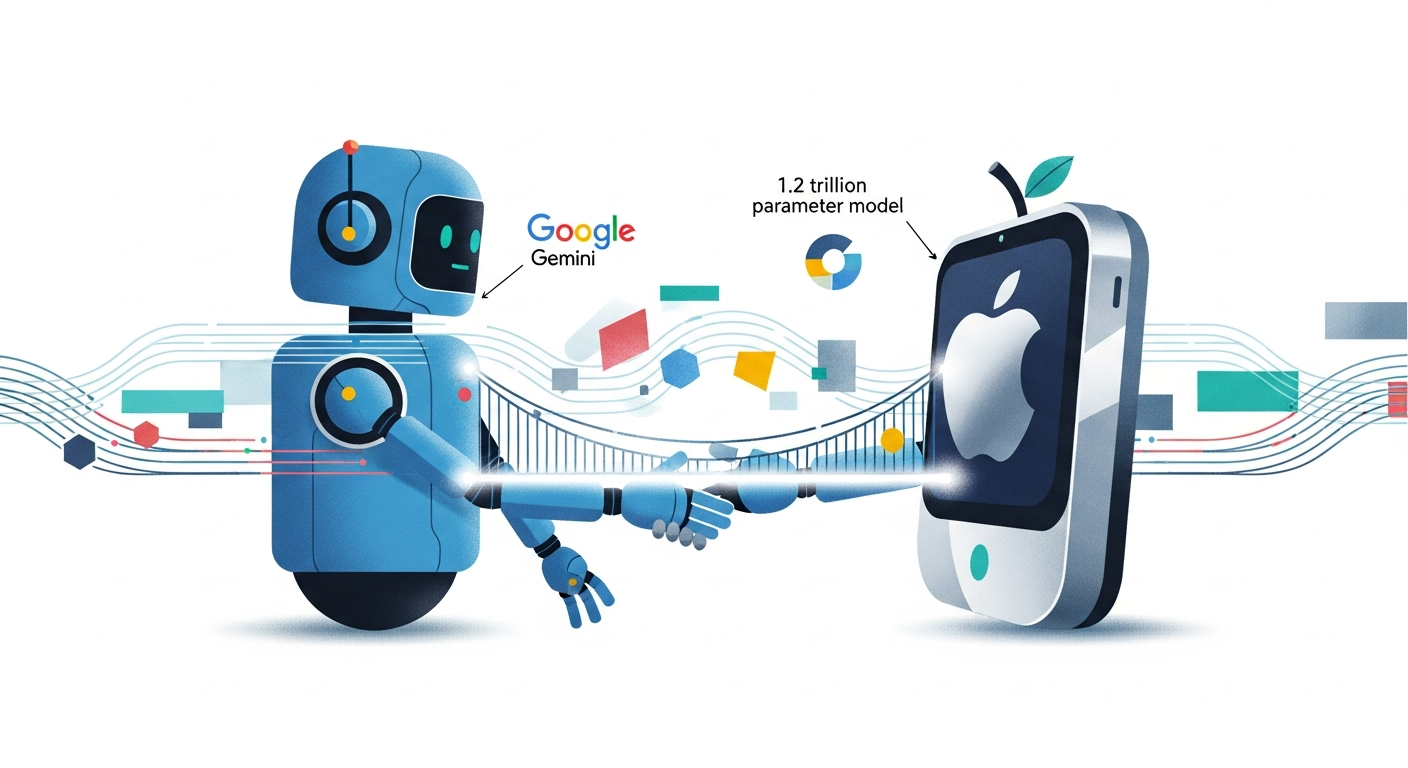
Apple is writing a billion-dollar check to Google every year to power the next generation of Siri with Gemini.
The custom 1.2 trillion parameter model will handle summarization and multi-step planning, running on Apple's Private Cloud Compute infrastructure with a planned Spring 2026 launch.
OpenAI just hit one million business customers, making it the fastest-growing business platform in history, with ChatGPT for Work now at 7 million seats after growing 40 percent in just two months.
In the AI music wars, Xania Monet became the first AI-generated artist to crack Billboard's radio charts, hitting number 30 on Adult RandB Airplay after viral TikTok success, despite pushback from artists like SZA and Kehlani.
Google is literally shooting for the stars with Project Suncatcher, unveiling plans for space-based AI infrastructure using solar-powered satellite constellations equipped with TPUs and terabit optical links to run machine learning workloads in orbit, with a two-satellite prototype targeted for 2027.
Anthropic is setting aggressive profitability targets, aiming to be cash-flow positive by 2027, three years ahead of OpenAI's 2030 goal, while projecting 70 billion in revenue by 2028, with Claude Code already hitting a billion-dollar annualized run rate.
DEEP DIVE ANALYSIS
Let's talk about what might be the most surprising partnership announcement of the year, and what it reveals about the current state of AI development. Apple paying Google a billion dollars annually to power Siri with Gemini isn't just a business deal, it's a strategic admission that changes how we need to think about the AI race.
Technical Deep Dive
This isn't just Apple licensing some off-the-shelf model. We're talking about a custom 1.2 trillion parameter version of Gemini, which is absolutely massive compared to the 150 billion parameters in Apple's current Apple Intelligence model.
To put that in perspective, that's eight times larger than what they're running now. The architecture here is fascinating. Google is essentially providing a mixture-of-experts model, similar to what we've been hearing about Gemini 2.
5 Flash. This means the model doesn't activate all 1.2 trillion parameters for every request.
Instead, it routes queries to specialized expert networks within the model, which is how you can achieve such massive scale while keeping inference costs manageable. Apple will run this on their Private Cloud Compute infrastructure, which is critical. They're not sending your data to Google's servers.
The model executes on Apple's hardware, maintaining their privacy stance while leveraging Google's AI capabilities. This is technically complex because you need to optimize a model trained on Google's TPUs to run efficiently on Apple's silicon architecture. The model will handle what Apple calls "summarizer" and "planner" functions.
The summarizer is relatively straightforward, condensing information, emails, notifications. But the planner is where it gets interesting. This is about multi-step reasoning, understanding context across conversations, and executing complex tasks that require maintaining state over time.
Current Siri struggles with anything beyond simple commands, and this is what Gemini is supposed to fix. Bloomberg's reporting suggests Apple also tested ChatGPT and Claude before choosing Gemini. The deciding factors likely came down to Gemini's strength in following complex instructions and maintaining long context windows.
Gemini's one million token context window means it can hold enormous amounts of conversation history and background information, which is essential for a voice assistant that needs to remember what you talked about yesterday.
Financial Analysis
A billion dollars per year. Let's unpack what that means financially for both companies. For Google, this is a validation play as much as a revenue play.
A billion annually isn't moving the needle much for a company with 300 billion in annual revenue, but having Apple as a showcase customer is worth far more than the contract value. This gives Google credibility in the enterprise AI market and demonstrates that even Apple, which prides itself on building everything in-house, had to come to Google for frontier AI capabilities. For Apple, this billion-dollar annual commitment reveals something more concerning.
They're essentially admitting they're at least two years behind in developing competitive AI models. Apple's stated goal is to replace Gemini with their own trillion-parameter model by the end of 2026, but given the complexity involved and their recent struggles, including the exodus of four to seven major AI researchers to Meta and competitors in recent months, that timeline looks optimistic. The economics of running inference for hundreds of millions of Siri users is staggering.
Even with Apple's Private Cloud Compute efficiency, we're talking about potentially billions of inference requests daily. Google's pricing for enterprise API access typically runs around one to five dollars per million tokens, but at Apple's scale, they've undoubtedly negotiated significantly lower rates. Still, a billion dollars annually suggests Apple expects to process an enormous volume of requests.
There's also an interesting margin consideration here. Apple Intelligence was supposed to be a key selling point for iPhone 16 and beyond. But if they're paying Google for the underlying intelligence, their margins on AI features are compressed.
This isn't sustainable long-term, which is why Apple views this as explicitly temporary. For context, Anthropic just announced they're aiming for 70 billion in revenue by 2028, with Claude Code alone hitting a billion-dollar annualized run rate. OpenAI is targeting 100 billion in revenue by 2028.
These numbers show how lucrative the AI platform business can be. Apple paying a billion just for model access highlights how much money is flowing through these AI ecosystems.
Market Disruption
Analysis This deal fundamentally reshapes the competitive landscape in several ways. First, it validates that the AI model layer and the application layer are separating. Apple built the most valuable consumer technology company by controlling the entire stack.
This Gemini deal breaks that pattern. They're admitting that in AI, vertical integration isn't currently feasible even for a company with their resources. For Google, this is a strategic win against Microsoft and OpenAI.
Microsoft's partnership with OpenAI gave them ChatGPT integration across Windows and Office. Google counters by powering the next generation of Siri on iOS. These competing integrations are carving up the consumer AI market.
The impact on OpenAI is particularly interesting. Remember, Apple already has a partnership with OpenAI for ChatGPT integration in iOS. But that's optional, opt-in.
This Gemini deal is for core Siri functionality that every iPhone user will access. That's a much bigger deal. OpenAI reportedly wants 100 billion in revenue by 2028, and losing potential pole position with Apple's billion-plus users hurts those projections.
For Anthropic and other AI labs, this demonstrates that frontier model development is even more expensive and difficult than previously thought. If Apple with unlimited resources can't build competitive models fast enough, what does that mean for smaller AI startups? We're seeing consolidation pressures increase.
The developer ecosystem impact is significant too. Apple has been positioning itself as the platform for AI applications through Apple Intelligence APIs and frameworks. But if the core intelligence comes from Google, does that change how developers think about building for iOS?
It potentially makes iOS more like Android in terms of AI capabilities, which could reduce Apple's differentiation. There's also a geopolitical dimension. The Bloomberg report notes this Gemini partnership won't work in China because Google is banned there.
Apple is pursuing separate deals with Alibaba and Baidu for Chinese users, complete with government-approved content filtering. This fragmentation of AI models across regions creates complexity for developers and potentially different user experiences based on geography.
Cultural and Social Impact
The Siri we've known for thirteen years is essentially being replaced. For hundreds of millions of users, this will be their first real interaction with frontier AI capabilities. That's a massive shift in how people experience AI, moving from frustrated "Siri, set a timer" interactions to potentially sophisticated multi-step assistance.
But there's a trust dimension here that's fascinating. Apple's entire brand promise around privacy, "what happens on your iPhone stays on your iPhone," is now complicated. Yes, the model runs on Apple's infrastructure, but it's Google's model.
How do users feel about that? Apple is betting they won't care or won't know, since Bloomberg reports Apple wants Google to remain "behind the scenes" and "unlikely to be promoted publicly." This lack of transparency is culturally significant.
Users will assume this is Apple's AI, not realizing Google is powering it. That raises questions about authenticity and disclosure in the AI age. When you interact with Siri in 2026, should you know you're actually talking to Gemini?
There's no regulatory requirement for this disclosure, but there's an ethical argument that users deserve to know. The competitive dynamics change user behavior too. Right now, if you want the best AI, you download ChatGPT or Claude as separate apps.
If Siri becomes genuinely capable, does that reduce people's willingness to try other AI assistants? Apple's distribution advantage is massive. Siri is on every iPhone, iPad, Mac, Apple Watch, and HomePod.
Default placement matters enormously in shaping user habits. There's also a cultural shift around AI capabilities. When Siri gets dramatically better in Spring 2026, user expectations for all voice assistants will rise.
Amazon's Alexa, Google Assistant, and others will face pressure to match or exceed these capabilities. This could accelerate the obsolescence of older voice assistant paradigms. For developers and creators, this signals that AI model development is increasingly a scale game.
The cultural narrative that anyone can train competitive models is being replaced by the reality that frontier capabilities require massive resources. This could reduce innovation diversity if only Google, OpenAI, Anthropic, and a few others can build models that companies like Apple consider good enough.
Executive Action Plan
If you're a technology executive, here are three specific actions to consider in response to this development: First, audit your AI dependency strategy immediately. Apple's decision reveals that even companies with nearly unlimited resources may not be able to build competitive AI models in-house on reasonable timelines. You need to honestly assess whether your company should be building models or integrating them.
Map out a two-track strategy: one assuming you successfully develop internal capabilities, another assuming you need to partner with model providers. Apple is now pursuing both paths, and that dual approach might be prudent for your organization. Second, rethink your integration contracts with model providers.
If you're currently using OpenAI, Anthropic, or Google's APIs, your contracts probably assume relatively stable pricing and availability. Apple's billion-dollar deal suggests that pricing for preferred access and custom models is going to be higher than current API rates. You should be negotiating longer-term commitments now, before pricing pressure increases.
Consider whether you need guaranteed capacity, custom versions, or specific SLA commitments. The market dynamics are shifting from "models as commodity APIs" to "strategic model partnerships." Position yourself accordingly.
Third, prepare for a world of model fragmentation across geographies and use cases. Apple needs different models for different regions due to regulatory requirements. Your company likely faces similar constraints.
Start planning your model orchestration strategy now. You need infrastructure that can route requests to different models based on user location, use case, and regulatory requirements. This isn't just technical architecture, it requires legal and compliance frameworks.
Companies that build robust model orchestration layers will have significant advantages as the regulatory landscape becomes more complex. Don't wait until you're forced to support multiple models, build that capability proactively.
Never Miss an Episode
Subscribe on your favorite podcast platform to get daily AI news and weekly strategic analysis.