OpenAI Signs $38 Billion AWS Deal, Ditches Microsoft Exclusivity
Episode Summary
Your daily AI newsletter summary for November 05, 2025
Full Transcript
TOP NEWS HEADLINES
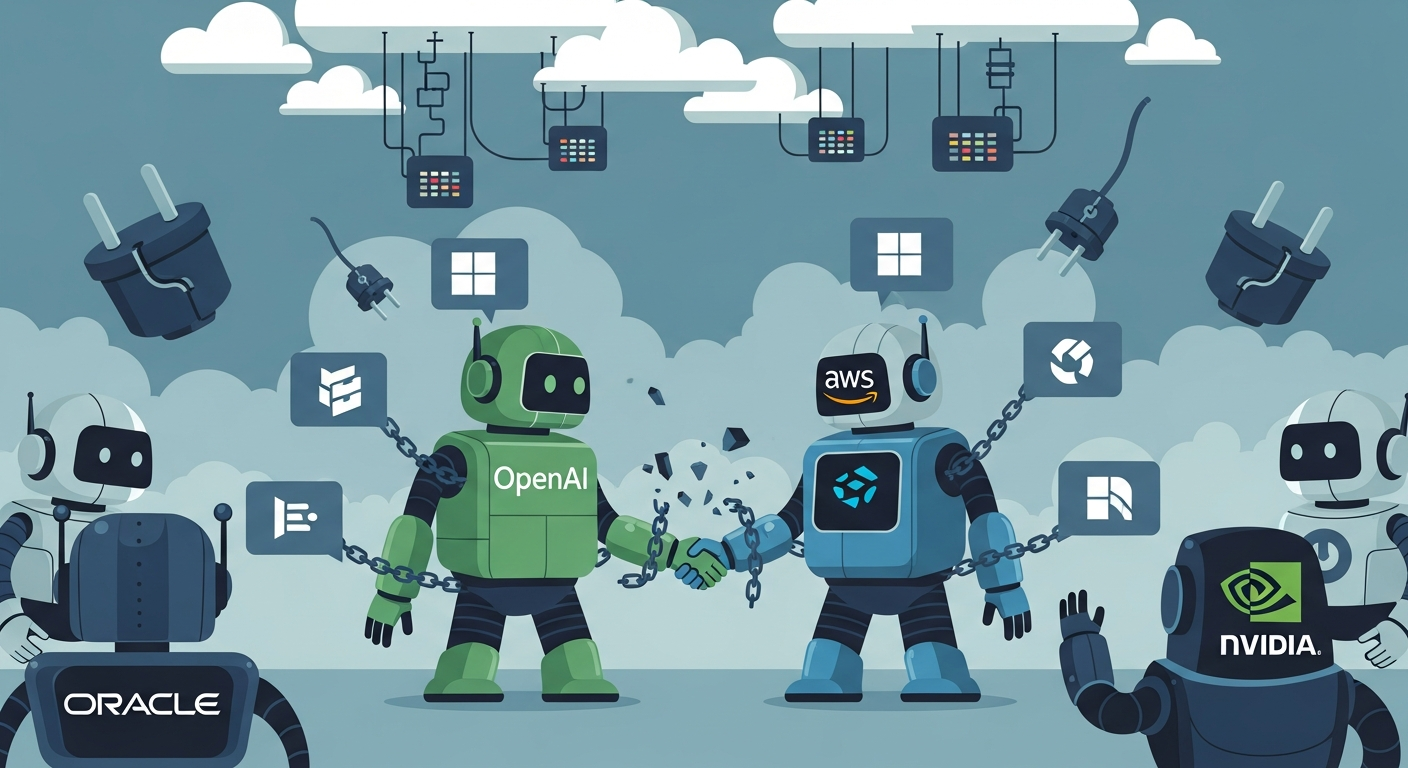
OpenAI just dropped a dollar 38 billion deal with Amazon Web Services over seven years, marking their biggest move away from Microsoft's cloud monopoly.
This comes right after they renegotiated their Microsoft contract to remove exclusivity requirements, and it's part of a staggering dollar 1.4 trillion infrastructure buildout that includes Oracle, Google, and Nvidia.
Microsoft countered with their own spending spree, signing a dollar 9.7 billion deal with data center operator IREN and a dollar 15 billion investment in the UAE.
But here's the kicker from Microsoft CEO Satya Nadella: the bottleneck isn't chips anymore—it's power.
He's literally got H100 GPUs collecting dust because there aren't enough data centers with electricity to plug them into.
Anthropic just secured Cognizant as one of their three largest enterprise customers, rolling out Claude to 350,000 employees.
Meanwhile, they're also predicting AGI by early 2027, which would require AI to go from completing hour-long tasks today to handling two-week projects in just eight months.
On the creative front, Coca-Cola doubled down on AI-generated holiday ads after last year's backlash, cutting production time from 12 months to 30 days.
And in music, AI-generated tracks have officially hit the Billboard charts while Udio settled their lawsuit with Universal Music Group by disabling downloads.
The regulatory hammer is starting to drop in some places—President Trump announced that NVIDIA's most advanced Blackwell chips will be restricted to US customers only, while major Japanese publishers including Studio Ghibli formally demanded OpenAI stop using their anime and manga for training.
And finally, a new benchmark called the Remote Labor Index tested AI on real Upwork freelance projects, and even the best systems like Claude and GPT-5 completed less than 3 percent of tasks at professional human standards, revealing a massive gap between benchmark hype and actual automation capability.
DEEP DIVE ANALYSIS
Let's dig into this OpenAI-Amazon deal, because it's not just another cloud contract—it's a window into the fundamental economics reshaping the AI industry, and it has massive implications for every technology executive listening.
Technical Deep Dive
First, the technical architecture here is fascinating. OpenAI is getting access to hundreds of thousands of NVIDIA GPUs—both the current GB200s and upcoming GB300s—clustered through Amazon's EC2 UltraServers. What makes this significant is the clustering architecture.
These aren't just individual GPUs sitting in racks; they're interconnected on the same network fabric to enable low-latency performance across massive compute clusters. We're talking about clusters exceeding 500,000 chips that can work in concert. This infrastructure supports the entire lifecycle of AI development—from training next-generation models to serving inference for ChatGPT's live interactions.
The flexibility built into this contract is crucial: it can scale from GPU-intensive training workloads to CPU-heavy agentic tasks that require tens of millions of CPU cores. The deployment timeline targets late 2026 for full capacity, with expansion potential through 2027. But here's what's really interesting: this deal represents OpenAI's explicit move toward multi-cloud architecture.
By removing Microsoft's exclusivity clause just last week and immediately signing this AWS deal, they're essentially building redundancy and negotiating leverage into their infrastructure strategy. From a technical resilience perspective, this is smart—you never want a single point of failure when you're serving hundreds of millions of users.
Financial Analysis
Now let's talk about the economics, because the numbers are absolutely staggering. This dollar 38 billion over seven years adds to OpenAI's broader dollar 1.4 trillion infrastructure commitment.
To put this in perspective, OpenAI is projected to generate dollar 13 billion in revenue this year. They're committing nearly three times their annual revenue just to this one deal. The financing model here is essentially pre-purchasing compute capacity at scale to lock in pricing and availability.
But the burn rate is astronomical. When investors or board members question the sustainability of spending that outpaces revenue by this magnitude, Sam Altman's response has been essentially: "If you want to sell your shares, I'll find you a buyer." That's either supreme confidence or concerning hubris, depending on your perspective.
What's happening across the industry is even more revealing. Microsoft isn't just buying cloud capacity—they're essentially creating what we might call "NeoCloud vassals." Their dollar 9.
7 billion IREN deal converted a bitcoin mining operation into an AI compute supplier overnight. These companies are taking Microsoft's contracts as collateral, borrowing billions from firms like Blackstone, and racing to build GPU capacity. It's a debt-fueled infrastructure arms race.
And yet, Satya Nadella revealed something crucial: Microsoft has H100 GPUs sitting idle because they lack the power infrastructure to run them. The constraint has shifted from silicon availability to electrical grid capacity and cooling infrastructure. This is a massive capital allocation problem—you can't just buy your way out of physics and utility company timelines.
Market Disruption
This deal fundamentally reshapes the competitive landscape in three ways. First, it validates AWS's position as the calm, solvent adult in the room. While Microsoft has been militarizing NeoCloud providers with debt-fueled expansion, AWS took the long view—stable infrastructure, profitable operations, and waiting for customers who need reliability over bleeding-edge speed.
Second, it fragments OpenAI's infrastructure dependence, which has strategic implications for Microsoft. Their exclusive cloud partnership was a competitive moat; losing that exclusivity weakens their position in the AI race. Other hyperscalers can now court frontier labs with compute offers without automatically losing to Microsoft's embedded relationship.
Third, this signals that the AI training and inference market is large enough to support multiple massive infrastructure providers. The total addressable market for AI compute isn't zero-sum among clouds—it's expanding so rapidly that there's room for AWS, Microsoft, Google, Oracle, and specialized providers like CoreWeave. But the broader industry disruption is around power and real estate.
We're about to see unprecedented demand for data center real estate near cheap, reliable power sources. Utilities are becoming kingmakers. Regions with available electrical capacity will see investment floods.
This will reshape commercial real estate valuations and urban planning.
Cultural and Social Impact
The cultural shift here is profound. We're watching the privatization of computational power on a scale that rivals the Manhattan Project. The difference is that this is happening through corporate balance sheets and debt markets rather than government appropriation.
For everyday users, this infrastructure build-out determines which AI capabilities become available and when. The fact that OpenAI is capacity-constrained means that access to advanced AI—despite being democratized through ChatGPT—is still fundamentally limited by infrastructure economics. We're in an era where compute capacity, not just algorithmic innovation, determines who wins.
There's also a concerning pattern emerging around labor economics. That Remote Labor Index benchmark showing less than 3 percent task completion at professional standards reveals something important: we're in AI's "dial-up era." The hype massively exceeds current capability for complex work.
But companies are already restructuring workforces based on the promise of AI automation, creating real pain for workers while the technology remains immature. And then there's the environmental elephant in the room. These data centers consume extraordinary amounts of power.
Microsoft's challenge finding "warm shells" is partly about electrical grid capacity that's already strained. As AI scales, we're creating a genuine tension between computational progress and environmental sustainability.
Executive Action Plan
So what should technology executives actually do with this information? Here are three concrete recommendations: First, diversify your AI infrastructure strategy now. If OpenAI—with all their resources and Microsoft backing—is building multi-cloud redundancy, your company should too.
Don't lock yourself into a single AI provider or cloud platform. Develop relationships with multiple model providers and cloud vendors. Test your critical AI workflows across different infrastructures.
The worst time to discover you need alternatives is during a capacity crunch or pricing negotiation. Second, treat power and cooling as strategic resources, not afterthoughts. If you're building AI capabilities in-house or expanding data center capacity, secure power commitments before you buy compute.
Talk to utilities about future capacity. Consider geographic location based on electrical grid reliability and cost, not just tax incentives. The companies that solve power infrastructure will have an asymmetric advantage over the next decade.
Third, recalibrate your AI automation timelines and investment theses. That 3 percent completion rate on real-world tasks is a wake-up call. Don't restructure your entire workforce or make irreversible commitments based on current AI capabilities scaling linearly.
Instead, focus on augmentation rather than replacement, invest in human-AI collaboration workflows, and maintain flexibility in your organizational design. The executives who navigate this transition successfully will be those who remain sober about current limitations while staying aggressive about long-term potential. The AI infrastructure race is fundamentally about who can spend the most, fastest, while maintaining enough revenue growth to justify the expenditure.
For most companies, the smarter play isn't trying to compete on that dimension—it's being thoughtful about how you leverage the infrastructure these giants are building while protecting your strategic flexibility.
Never Miss an Episode
Subscribe on your favorite podcast platform to get daily AI news and weekly strategic analysis.