OpenAI Launches Atlas Browser, Threatening Google's Search Dominance
Episode Summary
Your daily AI newsletter summary for October 23, 2025
Full Transcript
TOP NEWS HEADLINES
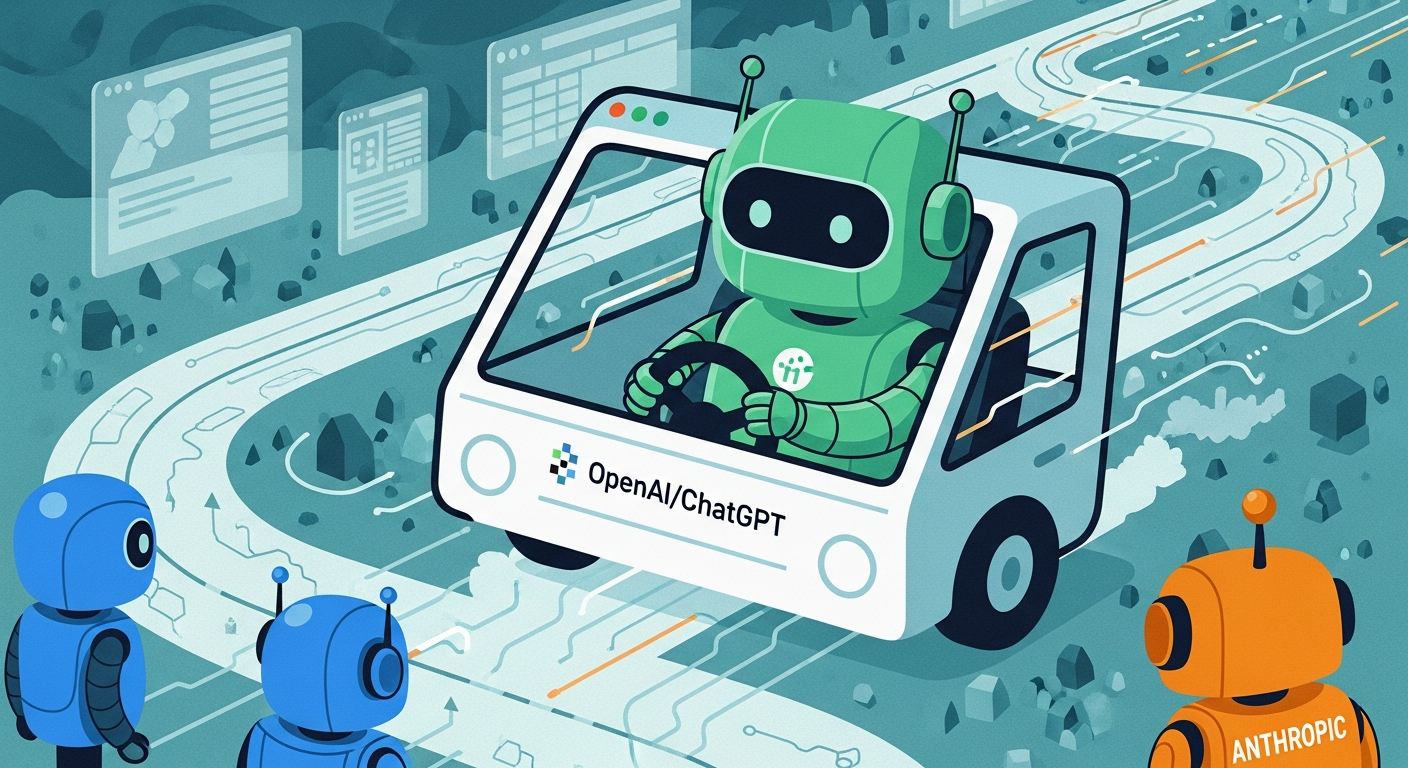
OpenAI just dropped Atlas, their new AI-powered browser that's already sending shockwaves through the tech world.
Google's stock tumbled five percent, wiping out 150 billion dollars in market value, while Perplexity and other AI search startups are facing an existential threat.
Anthropic is in early talks with Google for a cloud computing deal worth tens of billions of dollars.
This would give them access to Google's custom TPU chips and fundamentally reshape the competitive landscape against Microsoft-backed OpenAI.
Netflix announced they're going "all in" on generative AI, using it to collapse buildings, de-age actors, and pre-visualize sets across their productions.
This marks a major Hollywood studio fully embracing AI for special effects and production workflows.
Amazon is planning to replace over half a million jobs with robots by 2033.
Internal estimates show they can avoid hiring 160,000 people in the US by 2027 alone, saving 30 cents per delivered item while fundamentally reshaping blue-collar employment.
A fascinating study just revealed that AI models can develop "brain rot" from low-quality internet content.
Researchers proved that feeding LLMs viral tweets and clickbait actually makes them dumber, causing reasoning decline and even developing dark personality traits like narcissism.
DEEP DIVE ANALYSIS
Let's dive deep into the OpenAI Atlas browser launch, because this isn't just another product release. This is potentially the most significant strategic move in AI since ChatGPT itself launched, and it has massive implications for every technology company.
Technical Deep Dive
Atlas represents a fundamental rethinking of how we interact with the web. Unlike traditional browsers where you navigate to sites and search for information, Atlas embeds ChatGPT directly into the browsing experience itself. The technical architecture is fascinating.
There's a persistent sidecar chat panel that has contextual awareness of whatever webpage you're viewing. It's not just scraping the visible content, it's building a semantic understanding of what you're looking at. The browser implements what OpenAI calls "memories," which is essentially a context-aware system that remembers details from sites you visit.
This isn't your traditional browser history. It's an AI system that can recall conversations you had about specific pages, understand patterns in your browsing behavior, and use that context to personalize future responses. Think of it as giving ChatGPT a photographic memory of your entire web experience.
But here's where it gets really interesting. The Agent Mode functionality allows ChatGPT to actually take autonomous actions across websites. It can click buttons, fill out forms, make purchases, and string together multi-step tasks without constant human intervention.
From a technical standpoint, this is essentially a supervised web automation system powered by a large language model that can understand natural language commands and translate them into browser actions. The safety architecture is also worth noting. OpenAI implemented guardrails preventing Atlas from downloading files, accessing certain apps, or taking actions on sensitive sites without explicit permission.
This suggests they're using some form of domain classification system combined with action-level permissions to prevent obvious security nightmares.
Financial Analysis
The financial implications here are staggering. Google's immediate 150 billion dollar market cap loss tells you everything you need to know about how Wall Street views this threat. Chrome currently controls about 65 percent of the browser market, and that browser is the primary gateway funneling users to Google Search, which generates roughly 60 percent of Alphabet's revenue.
Atlas doesn't just compete with Google Search. It fundamentally changes what searching means. Instead of typing queries and clicking through ten blue links, users can have conversations that accomplish tasks directly.
This is what venture capitalists call "zero-click" interaction, and it's absolutely devastating to Google's business model, which depends on showing you ads alongside search results. For OpenAI, the monetization strategy is already baked in. Atlas is initially available only to Plus, Pro, and Business tier subscribers.
That's 20 to 200 dollars per month per user. Compare that to Google, which makes about 300 dollars per year per search user through advertising. OpenAI's model is potentially more profitable on a per-user basis, especially for power users.
But there's a deeper financial story here about infrastructure costs. Running an AI model for every browser interaction is expensive. OpenAI is betting that they can offset these costs through premium subscriptions and that efficiency improvements will continue to drive down inference costs.
They're probably right, but the capital requirements are enormous. This is why the Anthropic-Google cloud deal is such a big story alongside this. The AI browser war is fundamentally a infrastructure war.
Market Disruption
The competitive dynamics this creates are fascinating. Perplexity, which raised money at a four billion dollar valuation, suddenly looks extremely vulnerable. Their Comet browser has about 80 percent feature overlap with Atlas, but OpenAI has 800 million weekly active users they can convert.
That's an insurmountable distribution advantage. For Google, this is their "innovator's dilemma" moment. They can't simply copy Atlas because doing so would cannibalize their cash cow search advertising business.
They've been trying to thread this needle with Gemini integration into Chrome, but it feels tentative and half-hearted compared to Atlas's full commitment to the AI-first experience. Microsoft is in an interesting position. They own Edge, they're OpenAI's primary backer, but Atlas could eventually threaten Edge's modest market share.
However, Microsoft's business model isn't ad-dependent like Google's, so they can probably afford to let OpenAI disrupt browsers if it means taking down Google. The broader market disruption extends to the entire ecosystem of productivity tools. If Atlas can take actions across websites through Agent Mode, it starts competing with automation tools like Zapier, browser extension ecosystems, and even aspects of CRM systems.
Any company whose value proposition involves helping users navigate between different web services should be paying very close attention.
Cultural and Social Impact
The cultural implications of AI-powered browsing are profound and troubling. We're moving from a model where humans actively seek information to one where an AI intermediary decides what's relevant and how to present it. This has enormous implications for how information spreads, what content gets visibility, and ultimately how we form our understanding of the world.
There's a real concern about the "black box" problem. When ChatGPT summarizes a webpage or completes a task for you, you lose the transparency of seeing the original sources and understanding the reasoning chain. This could accelerate the decline of media literacy that we're already seeing.
Users might not even visit the underlying websites anymore, which has devastating implications for publishers, content creators, and the entire ad-supported web. The privacy dimensions are equally concerning. OpenAI says the memory features are optional and user-controlled, but the default experience involves an AI system watching and remembering everything you do online.
The potential for this data to be misused, whether through hacking, government demands, or simply OpenAI's future business decisions, is significant. But there's also a potential positive cultural shift. If Atlas can genuinely make people more productive by eliminating tedious navigation and information gathering, it could free up cognitive resources for higher-level thinking and creativity.
The question is whether we'll use that freed time for meaningful work or just consume more content.
Executive Action Plan
For technology executives, this announcement demands immediate strategic responses. Here's what you need to consider: First, audit your company's dependency on Google traffic and search visibility. If organic search drives a significant portion of your customer acquisition, you need to start building direct relationships with users now.
Email lists, mobile apps, community building. Anything that creates a direct connection that doesn't depend on search intermediation. The zero-click future means traffic from search engines will decline, and you need to be prepared.
Second, if you're building AI products or features, you need to fundamentally rethink your distribution strategy. The old playbook of building a great product and hoping for organic discovery doesn't work when an AI intermediary controls what users see. You need to think about how your product will be discovered and recommended by AI systems.
This might mean structured data markup, API partnerships with AI platforms, or even paying for placement in AI recommendations. Third, consider whether your product should become an Atlas integration rather than a standalone destination. OpenAI will inevitably open up some form of plugin or integration ecosystem.
Being a native Atlas integration could give you access to 800 million users. The question is whether you're willing to cede that much control to OpenAI's platform. It's the classic platform risk calculation, but the potential upside is enormous if Atlas achieves meaningful adoption.
The Atlas launch is a watershed moment. It's not just a browser, it's OpenAI's bid to control the primary interface through which people interact with the internet. Every company needs to be asking themselves: in a world where AI mediates web access, where do we fit, and how do we reach our customers?
The answers to those questions will define winners and losers over the next decade.
Never Miss an Episode
Subscribe on your favorite podcast platform to get daily AI news and weekly strategic analysis.