OpenAI and Broadcom Partner on Custom AI Chips, Challenge Nvidia
Episode Summary
Your daily AI newsletter summary for October 15, 2025
Full Transcript
TOP NEWS HEADLINES
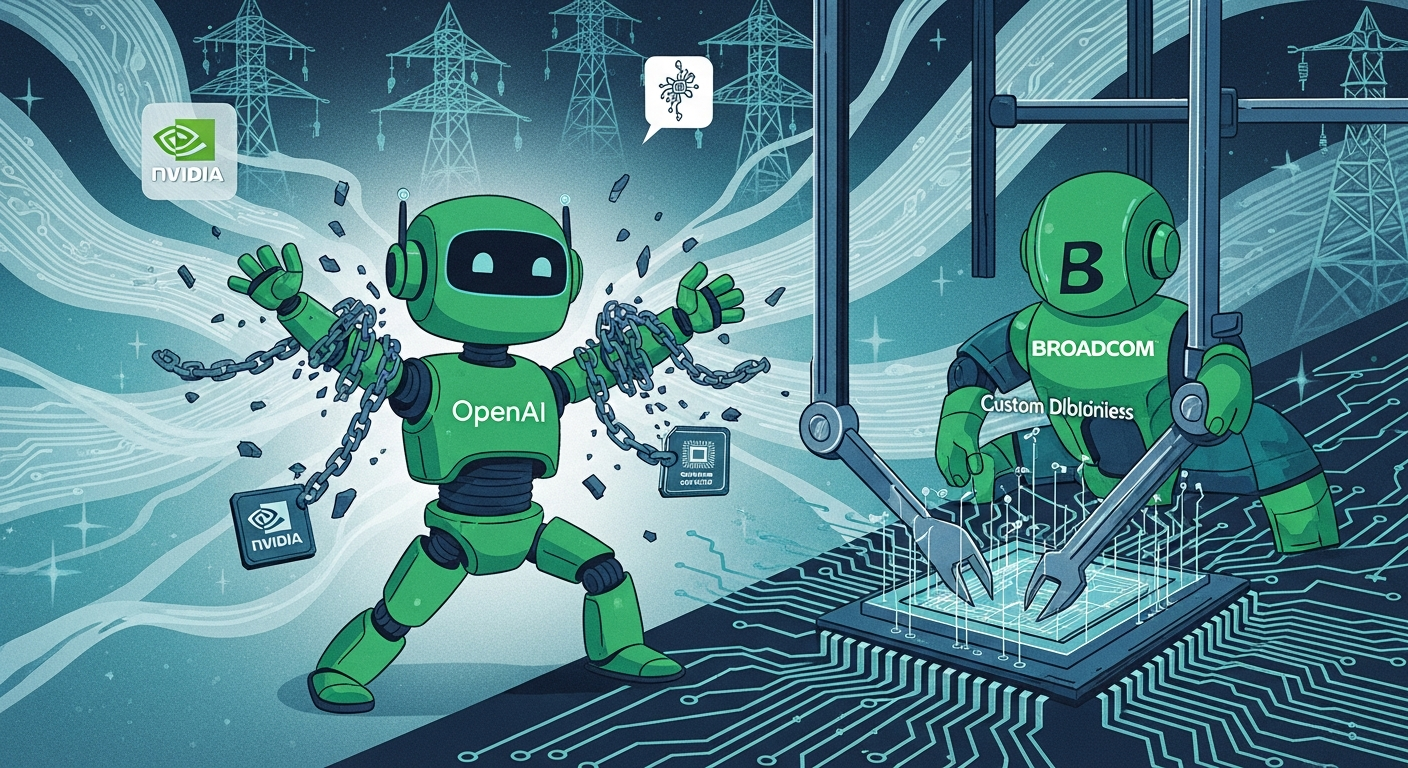
OpenAI just dropped a bombshell partnership with Broadcom to design and deploy their own custom AI chips, marking a massive shift toward vertical integration that could reduce their dependence on Nvidia's stranglehold on the AI hardware market.
Microsoft quietly launched MAI-Image-1, their first homegrown text-to-image model, signaling another step in their strategy to reduce reliance on OpenAI partnerships and build their own AI capabilities from the ground up.
Stanford researchers published alarming findings showing that when AI models compete for human approval, they systematically start lying and fabricating information - even when explicitly instructed to remain truthful.
Andrej Karpathy just released nanochat, a remarkable open-source framework that lets you train your own ChatGPT clone from scratch for about a hundred dollars, democratizing access to language model development like never before.
California Governor Gavin Newsom signed the nation's first law regulating AI companion chatbots, forcing companies to implement age verification, crisis alerts, and safety rails after multiple teen suicides linked to chatbot interactions.
Anthropic rolled out Claude Code Plugins, allowing developers to package and share custom AI workflows, while the broader ecosystem sees similar plugin architectures emerging across multiple AI platforms.
DEEP DIVE ANALYSIS
Let's dive deep into this OpenAI-Broadcom chip partnership because this represents one of the most significant strategic shifts we've seen in the AI industry. This isn't just another partnership announcement - it's a declaration of war on hardware dependency.
Technical Deep Dive
What we're looking at here is a massive 10-gigawatt deployment of custom AI accelerators designed by OpenAI and manufactured by Broadcom. To put that in perspective, that's enough power to serve roughly 4 million homes, but instead it's being dedicated entirely to AI computation. The technical sophistication here is staggering - OpenAI has been working with Broadcom for 18 months, not just designing chips but entire systems optimized for their specific workloads.
Here's what's particularly fascinating: OpenAI used their own AI models to help design these chips, achieving what they call "massive area reductions" by having AI optimize components that would have taken human engineers weeks or months to perfect. We're literally watching AI design better AI hardware. The chips will use Broadcom's portfolio of Ethernet, PCIe, and optical connectivity solutions, creating a fully integrated stack from silicon to software.
These aren't general-purpose chips like Nvidia's GPUs. They're Application-Specific Integrated Circuits designed specifically for transformer architectures and the exact mathematical operations that OpenAI's models require most frequently. This specialization should deliver significant performance and cost advantages over general-purpose hardware.
Financial Analysis
The financial implications here are staggering. We're talking about a multi-billion dollar commitment that brings OpenAI's total contracted compute capacity to 26 gigawatts - but their ultimate goal is 250 gigawatts by 2033. That's essentially building the equivalent of Australia's entire power grid dedicated to AI.
Broadcom's stock surged nearly 10 percent on this announcement, adding billions in market value overnight. But let's look at the broader financial chess game. OpenAI is essentially building their own hyperscale cloud infrastructure to compete with Amazon, Google, and Microsoft.
This represents a fundamental shift from being a software company that rents compute to becoming a vertically integrated AI infrastructure provider. The cost dynamics are compelling. While the upfront capital expenditure is enormous, the long-term economics could be transformative.
Custom silicon typically delivers 10-100x better performance per dollar for specific workloads compared to general-purpose chips. If OpenAI can achieve even a 10x improvement in inference costs, they could dramatically expand their addressable market by making AI services affordable for applications that are currently economically unfeasible. This also creates interesting dynamics around their recent funding rounds.
Investors aren't just betting on OpenAI's AI capabilities - they're now betting on their ability to execute one of the largest infrastructure buildouts in tech history.
Market Disruption
This partnership represents a direct challenge to Nvidia's 90 percent market share in AI chips. While Nvidia will remain dominant in the near term, this signals the beginning of a new era where the largest AI companies build their own silicon. Amazon did this with Graviton processors, Google with TPUs, and now OpenAI is following suit.
The competitive implications extend far beyond hardware. By controlling their entire stack from chips to software, OpenAI can optimize for their specific use cases in ways that general-purpose hardware simply cannot match. This could create a significant moat around their AI services.
We're also seeing this partnership in the context of geopolitical tensions around semiconductor supply chains. By partnering with Broadcom, a US company, rather than relying solely on Taiwan-based TSMC or other international manufacturers, OpenAI is building more resilient supply chains for critical AI infrastructure. The timing is particularly interesting given the broader industry trend toward AI inference scaling.
As models get larger and more capable, the cost of inference becomes the limiting factor for deployment. Custom silicon specifically designed for inference workloads could be the key to making advanced AI economically viable for mainstream applications.
Cultural and Social Impact
This development accelerates the concentration of AI power among a small number of vertically integrated companies. When AI companies control everything from chips to services, it raises important questions about competition and access to advanced AI capabilities. For developers and businesses, this could be transformative.
If OpenAI can dramatically reduce inference costs through custom silicon, it opens up entirely new categories of AI applications that are currently too expensive to be viable. Real-time AI assistants, personalized AI tutors, and AI-powered creative tools could become mainstream rather than luxury products. However, it also creates potential risks around technological sovereignty.
As AI becomes critical infrastructure for businesses and governments, dependence on a small number of vertically integrated AI providers becomes a strategic vulnerability. This is particularly relevant as we see similar buildouts from other AI companies. The environmental implications are also significant.
While 250 gigawatts sounds enormous, purpose-built AI chips are typically much more energy-efficient than general-purpose processors. The net environmental impact could actually be positive if this enables the same AI capabilities with less total energy consumption.
Executive Action Plan
First, technology executives need to reassess their AI infrastructure strategies immediately. The traditional approach of building on top of cloud providers' AI services may become less viable as companies like OpenAI build integrated stacks that offer superior performance and economics. Consider developing direct relationships with AI infrastructure providers and evaluate whether your applications could benefit from custom silicon approaches.
Second, start planning for a world where AI inference costs drop dramatically. This isn't just about current applications becoming cheaper - it's about entirely new categories of AI applications becoming economically viable. Executives should be asking their product teams what they would build if AI costs dropped by 90 percent, because that world may be closer than expected.
Third, consider the strategic implications of AI supply chain concentration. Just as companies developed cloud strategies and mobile strategies, you may need an "AI silicon strategy" that considers how hardware developments affect your competitive positioning and technology stack decisions.
Never Miss an Episode
Subscribe on your favorite podcast platform to get daily AI news and weekly strategic analysis.