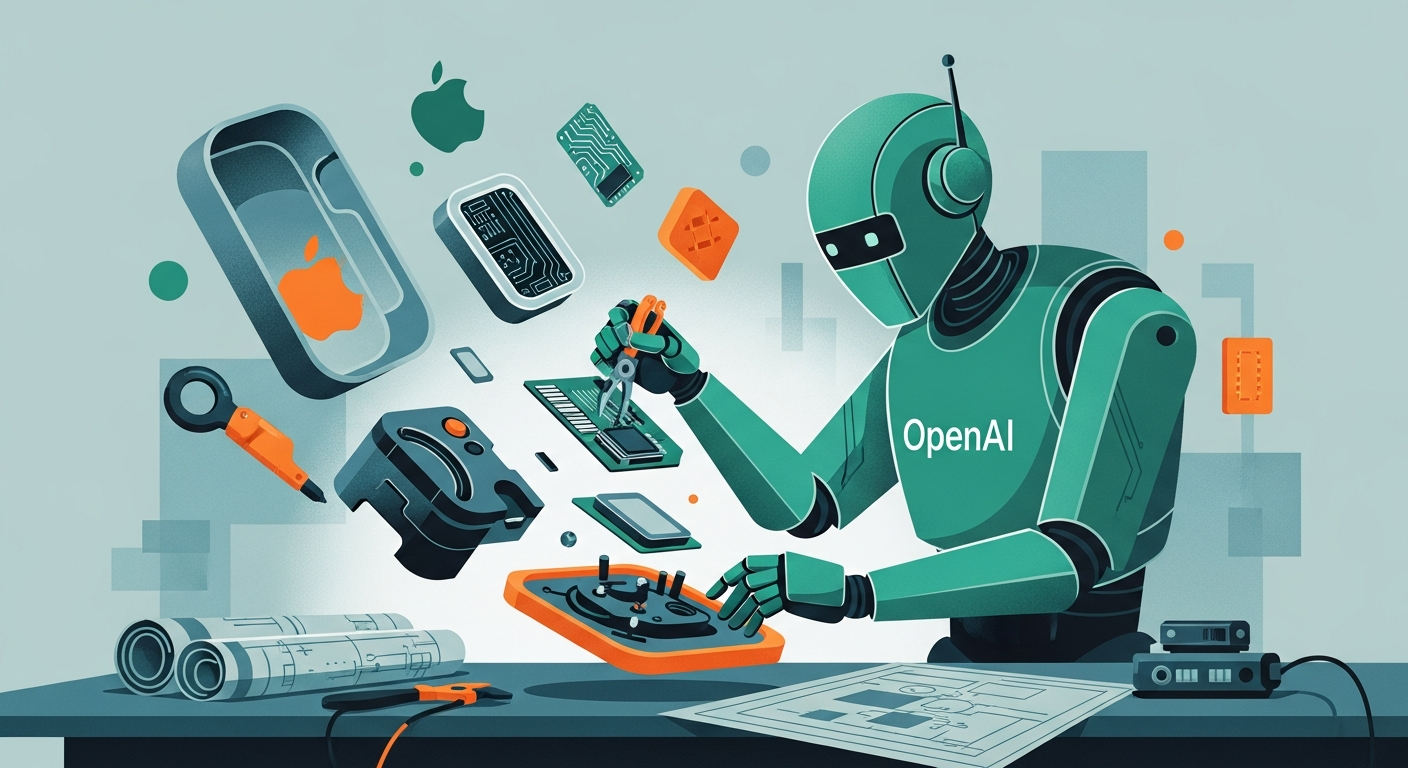
OpenAI Recruits Apple Veterans to Build AI Hardware Devices
Episode Summary
Your daily AI newsletter summary for September 23, 2025
Full Transcript
TOP NEWS HEADLINES
OpenAI is on a massive hiring spree, poaching dozens of Apple hardware veterans with million-dollar-plus packages to build their upcoming AI device lineup, including a display-less smart speaker and potentially AR glasses set to launch in late 2026. xAI just dropped Grok 4 Fast, delivering near-frontier AI performance while using 40 percent fewer thinking tokens than its predecessor, resulting in a staggering 98 percent price reduction while maintaining top-tier capabilities.
Waymo's latest safety study analyzed over 56 million autonomous miles and found their robotaxis reduce serious injuries by 85 percent, intersection crashes by 96 percent, and pedestrian incidents by 92 percent compared to human drivers.
Oracle is reportedly negotiating a massive dollar 20 billion cloud computing deal with Meta to provide AI model training and deployment capacity, as the infrastructure arms race intensifies.
YouTube unveiled over 30 new AI creator tools including an Ask Studio assistant and automated A/B testing for titles and thumbnails, while Notion's new AI agents launched with a critical security vulnerability that could expose private data.
Tesla dropped hints about building both a Cyber SUV and a smaller international version of the Cybertruck, with design mockups appearing in recent promotional videos.
DEEP DIVE ANALYSIS
Let's dive deep into what I consider the most strategically significant story here - OpenAI's aggressive move into hardware by systematically recruiting Apple's top talent. This isn't just another tech hiring story; this represents a fundamental shift in how AI companies are thinking about their future.
Technical Deep Dive
OpenAI is essentially reverse-engineering Apple's entire hardware playbook. They've brought on Tang Tan, a former Apple executive, to lead their hardware efforts, and they're specifically targeting Apple's interface designers, audio engineers, and manufacturing specialists. But here's what's technically fascinating - they're not just building generic devices.
The reports indicate they're creating a "display-less, smart speaker-type device" as their first product, which suggests they're betting on voice-first AI interactions rather than traditional screen-based computing. This approach makes technical sense when you consider OpenAI's strength in large language models. A display-less device forces interaction through natural language, playing directly to their core competency.
The technical challenge isn't just the hardware - it's creating seamless voice AI that can handle complex, multi-turn conversations without the visual cues that screens provide. They're also reportedly considering AR glasses and pin wearables, which indicates they're thinking about ambient computing - AI that exists in your environment rather than locked behind an app interface. The audio engineering talent they're hiring suggests they're focusing heavily on spatial audio, noise cancellation, and natural speech processing in noisy environments.
Financial Analysis
The financial implications here are staggering. OpenAI is offering million-dollar-plus packages to poach Apple talent, and they've secured manufacturing partnerships with Luxshare and Goertek - the same companies that build iPhones. This isn't cheap.
Manufacturing partnerships of this scale typically require hundreds of millions in upfront commitments. But here's the strategic financial play - OpenAI is currently paying massive compute costs to serve their AI models. By controlling the hardware stack, they can optimize for their specific AI workloads, potentially reducing serving costs per interaction.
Think about it: if you control the chip, the device architecture, and the AI model, you can create efficiencies that no software-only company can match. The revenue model is intriguing too. Unlike traditional hardware companies that make money on device sales, OpenAI could use hardware as a distribution mechanism for their AI services.
Imagine paying dollar 200 for a device that gives you premium access to GPT models that would normally cost dollar 20 per month. The hardware becomes a customer acquisition tool rather than a profit center.
Market Disruption
This move directly challenges the entire smartphone-centric computing paradigm. Apple has built a trillion-dollar business around the iPhone as the primary computing interface. OpenAI is betting that AI-first devices can bypass that entirely.
The competitive implications are massive. Google, Amazon, and Microsoft all have voice assistants, but they're built on top of existing hardware ecosystems. OpenAI is building from the ground up with AI as the primary interface, not a secondary feature.
For Apple specifically, this is existential. Their entire Services revenue - which now generates over dollar 80 billion annually - depends on iPhone users staying within their ecosystem. If AI-first devices can provide better, more natural interactions, the iPhone's dominance isn't guaranteed.
The broader market disruption extends to app stores, mobile advertising, and even social media platforms. If people interact primarily through voice with AI agents rather than visual apps, the entire mobile software ecosystem could be upended.
Cultural and Social Impact
We're looking at a potential shift from screen-based to ambient computing. This could fundamentally change how humans interact with technology on a daily basis. Instead of pulling out phones and opening apps, we might simply speak to our environment and get intelligent responses.
The privacy implications are enormous. Always-listening devices with advanced AI processing raise questions about data collection, storage, and analysis that make current smartphone privacy concerns look simple. When your AI assistant can understand context, emotion, and subtle verbal cues, the amount of personal data being processed increases exponentially.
There's also the social interaction angle. Voice-first AI could either make technology more natural and human-like, or it could further isolate people from direct human interaction. The design choices OpenAI makes will significantly influence which direction this goes.
Executive Action Plan
For technology executives, this development demands immediate strategic response. First, evaluate your company's dependency on current platform ecosystems. If you're heavily invested in mobile app development or platform-specific integrations, start diversifying now.
Begin experimenting with voice interfaces and conversational AI to understand how your products might work in a post-smartphone world. Second, assess your AI capabilities honestly. OpenAI's hardware move is only possible because of their strength in large language models.
If your competitive advantage relies on traditional software approaches, you need to either build AI capabilities internally or establish strong partnerships with AI providers. The companies that survive this transition will be those that can seamlessly integrate AI into their core value proposition. Third, consider the data and privacy implications for your organization.
As AI-first devices become more prevalent, customer expectations around privacy and data control will evolve rapidly. Start building transparent, user-controlled data practices now, before they become regulatory requirements. The companies that establish trust in this new AI-ambient world will have significant competitive advantages as these devices scale.
Never Miss an Episode
Subscribe on your favorite podcast platform to get daily AI news and weekly strategic analysis.