GPT-5 Dominates Programming World Finals, Surpasses Human Competitors
Episode Summary
Your daily AI newsletter summary for September 20, 2025
Full Transcript
TOP NEWS HEADLINES
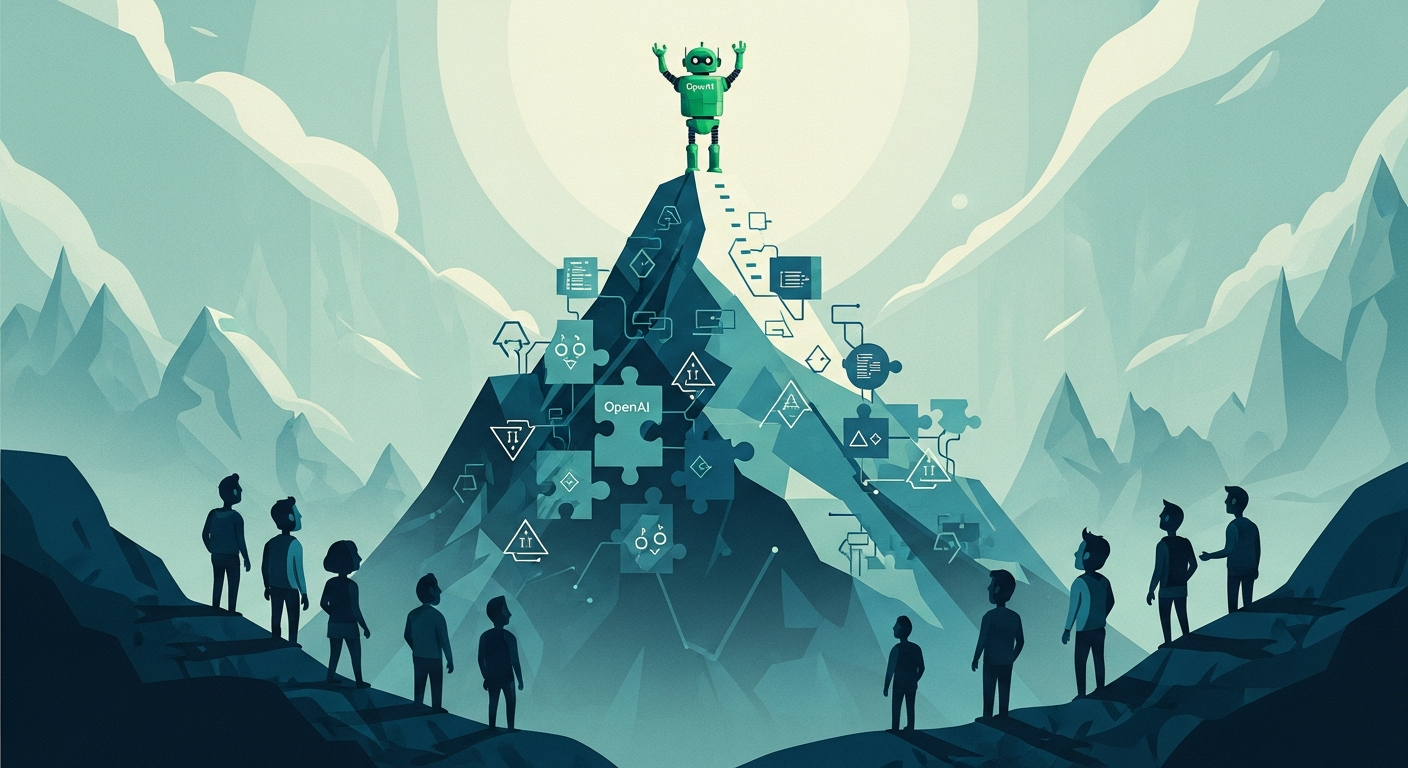
OpenAI's latest models just achieved something unprecedented - they completely dominated the world's most prestigious programming competition, with GPT-5 solving all twelve problems perfectly while the best human teams could only manage eleven.
This isn't just incremental progress, it's a clear demonstration that AI has officially surpassed human ability in complex algorithmic problem-solving.
Meta unveiled their neural-controlled smart glasses at Connect, introducing a wristband that reads muscle signals to control display glasses before you even move your fingers.
The Ray-Ban Display glasses start at dollar 799 and represent Meta's ambitious play to make brain-computer interfaces mainstream rather than science fiction.
Google is rolling out Gemini integration across Chrome for all US users, turning the world's most popular browser into an AI-native platform that can understand context across tabs and perform autonomous tasks like booking appointments and ordering groceries.
This move transforms Chrome from a passive web viewer into an active AI assistant.
Research teams at Stanford and the Arc Institute successfully used AI to design entirely new viruses from scratch that actually work in laboratory tests.
Out of 302 attempts, 16 AI-generated viruses proved functional, including variants that could break through bacterial defenses where natural viruses failed.
China escalated the chip war by banning domestic tech companies from purchasing any Nvidia AI processors, including the specially-designed RTX Pro 6000D that was created specifically to comply with US export restrictions.
This represents a complete reversal from buyer to ban, potentially costing Nvidia billions in lost revenue.
DEEP DIVE ANALYSIS
Let's dive deep into what many are calling a watershed moment in AI development - OpenAI and Google's complete domination of the International Collegiate Programming Contest World Finals. This isn't just another benchmark milestone; it's a fundamental shift in the relationship between human and artificial intelligence in complex problem-solving.
Technical Deep Dive
The ICPC World Finals isn't your typical coding challenge. These are algorithmic problems that require deep mathematical insight, complex data structure manipulation, and the kind of creative problem-solving that has traditionally been the exclusive domain of the brightest human minds. When GPT-5 solved all twelve problems - including ones that stumped every human competitor - it demonstrated something profound about reasoning capabilities.
What makes this particularly significant is the ensemble approach OpenAI used. Rather than relying on a single model, they orchestrated multiple reasoning systems working together, with some problems solved on the first attempt. Google's Gemini 2.
5 Deep Think took a different approach, using extended reasoning time to work through problems that no human team could crack. This isn't brute force computation - it's sophisticated reasoning about abstract mathematical relationships and algorithmic efficiency. The technical implications are staggering.
These systems are now demonstrably superior at tasks that require multi-step logical reasoning, pattern recognition in complex domains, and the ability to synthesize knowledge across different mathematical and computational concepts. We're witnessing the emergence of artificial reasoning that doesn't just match human cognitive patterns but potentially surpasses them in systematic problem-solving.
Financial Analysis
The financial implications of this breakthrough ripple across the entire technology ecosystem. OpenAI's reasoning capabilities justify their massive infrastructure investments - their Codex platform is already generating significant revenue from enterprise customers who need exactly these kinds of complex problem-solving abilities. When every engineering department at OpenAI uses Codex daily, as their internal reports show, you're looking at productivity multipliers that translate directly to bottom-line impact.
For Google, this validates their enormous AI investments and positions Gemini as a legitimate competitor to OpenAI in the high-value enterprise market. The integration into Chrome represents a distribution play worth billions - turning their browser monopoly into an AI services delivery mechanism. But the broader financial story is about labor economics.
If AI can outperform the world's best programmers at the most challenging algorithmic tasks, we're approaching a inflection point where the premium for human coding expertise begins to compress. Companies like GitHub, which built Copilot around AI-assisted coding, are positioned to capture enormous value as the gap between AI and human capability widens. The startup ecosystem should pay particular attention here.
The barriers to building complex software products are dropping rapidly. When AI can handle the most sophisticated algorithmic challenges, smaller teams can tackle problems that previously required large engineering organizations.
Market Disruption
This represents a seismic shift in competitive dynamics across the software industry. Traditional competitive moats built on having the smartest engineering teams are eroding rapidly. Companies like Palantir, which built their entire value proposition around having superior algorithmic capabilities, now face AI systems that can potentially replicate their core technical advantages.
The cloud infrastructure providers - AWS, Azure, Google Cloud - are about to see a massive surge in demand as companies rush to integrate these reasoning capabilities into their products. But the real disruption is in professional services. Consulting firms that charge premium rates for complex system design and algorithmic solutions are facing potential disintermediation.
Educational institutions teaching computer science need to fundamentally rethink their curricula. Teaching syntax and basic algorithmic thinking becomes less valuable when AI can handle complex implementation. The focus shifts to AI collaboration, system architecture, and the kinds of creative problem-solving that remain uniquely human.
Cultural and Social Impact
We're witnessing the democratization of programming expertise, but also the potential obsolescence of a highly-skilled profession. The cultural impact mirrors what happened to chess after Deep Blue - the nature of human expertise shifts from raw capability to collaboration with AI systems. For developers, this creates both opportunity and anxiety.
Junior developers might find AI levels the playing field, allowing them to tackle problems previously reserved for senior engineers. But senior developers face questions about the future value of expertise that machines can replicate. The broader social implication is about cognitive labor.
If AI can master the most abstract and complex forms of human reasoning, we're approaching questions about the fundamental value and uniqueness of human intelligence in professional contexts. This isn't just about coding - it's about any domain that requires systematic problem-solving and logical reasoning.
Executive Action Plan
First, immediately audit your engineering organization's AI adoption strategy. If OpenAI's internal teams use Codex daily across every department, your competitive position depends on achieving similar integration levels. Don't just pilot AI tools - commit to systematic deployment across your technical teams.
The productivity gains are no longer theoretical; they're demonstrated competitive advantages. Second, accelerate your timeline for AI-native product development. If your company has been cautiously experimenting with AI features, this breakthrough suggests the window for gradual adoption is closing.
Companies that don't embed AI reasoning capabilities into their core products risk being outmaneuvered by competitors who do. Third, rethink your hiring and talent development strategy. The premium for traditional coding skills is about to shift dramatically.
Focus hiring on AI collaboration skills, system design thinking, and domain expertise that complements rather than competes with AI capabilities. Your most valuable engineers will be those who can effectively orchestrate AI systems rather than those who can implement complex algorithms from scratch.
Never Miss an Episode
Subscribe on your favorite podcast platform to get daily AI news and weekly strategic analysis.