Oracle's $300 Billion OpenAI Deal Reshapes AI Infrastructure Race
Episode Summary
Your daily AI newsletter summary for September 12, 2025
Full Transcript
TOP NEWS HEADLINES
Oracle just made Larry Ellison the world's richest person overnight with a dollar 300 billion AI infrastructure deal with OpenAI - that's one of the largest cloud contracts in history, showing just how much compute power the AI race really requires.
Replit raised dollar 250 million at a dollar 3 billion valuation while launching Agent 3, their new coding AI that can work autonomously for 200 minutes straight - ten times longer than previous versions - essentially turning anyone into a software developer.
Microsoft is diversifying away from OpenAI by integrating Anthropic's Claude into Office 365, reportedly because Claude performs better at creating spreadsheets and PowerPoint presentations than GPT models.
Mira Murati's new startup just solved a fundamental AI problem that engineers thought was unfixable - they figured out how to make AI models give consistent, reproducible answers instead of different responses to identical questions.
ByteDance released Seedream 4.0, claiming it beats Google's Nano Banana image generator, while major publishers including Reddit and Yahoo launched a new protocol to get paid when AI companies scrape their content.
Apple quietly downplayed AI at their iPhone 17 launch, focusing on hardware improvements instead of intelligence features, suggesting they might be losing ground in the AI assistant race.
DEEP DIVE ANALYSIS
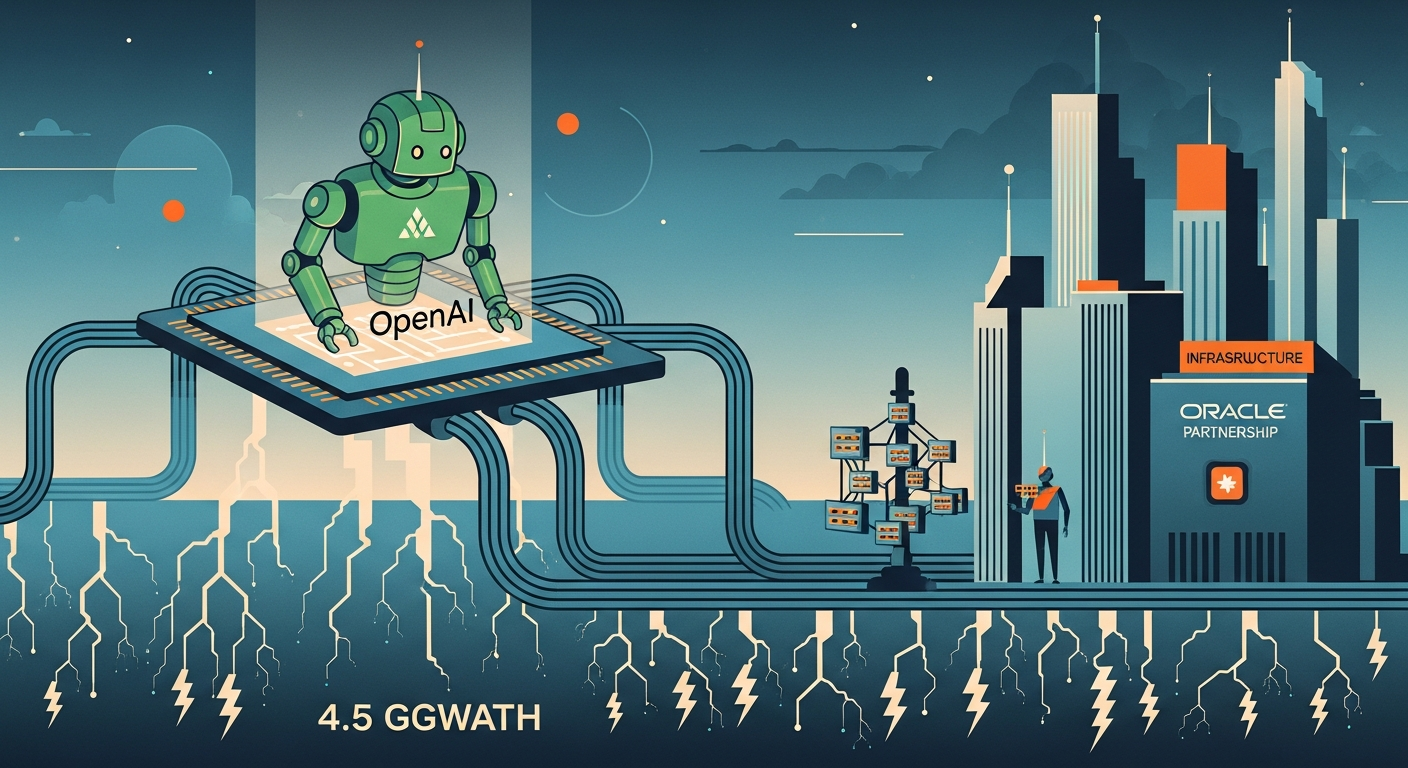
Let's dive deep into what might be the most significant business story in AI right now - Oracle's dollar 300 billion deal with OpenAI and what it tells us about the infrastructure arms race that's reshaping the entire technology landscape.
Technical Deep Dive
This isn't just about servers and storage - we're looking at a fundamental shift in how AI infrastructure works. OpenAI needs massive computational power to train and run their models, requiring specialized GPU clusters that can handle the parallel processing demands of large language models. Oracle is providing what's called "disaggregated infrastructure" - essentially compute resources that can be dynamically allocated based on real-time needs rather than fixed server farms.
The deal requires 4.5 gigawatts of power capacity - that's enough electricity to power roughly four million homes. To put this in perspective, that's more power consumption than entire cities.
This massive energy requirement explains why we're seeing AI companies partner with nuclear power providers and why data center locations are increasingly driven by access to clean, reliable electricity rather than just fiber optic connections.
Financial Analysis
The numbers here are staggering. OpenAI's current annual revenue is estimated around dollar 3-4 billion, yet they're committing to dollar 60 billion annually starting in 2027 for compute alone. This suggests OpenAI is betting on exponential revenue growth - they'll need to increase their revenue by at least 15-20x just to cover their infrastructure costs.
For Oracle, this represents a complete transformation. Their cloud infrastructure revenue is projected to grow from dollar 18 billion this year to dollar 144 billion within five years - almost entirely locked in through signed contracts. Larry Ellison's net worth jumped over dollar 100 billion in a single day, making him temporarily richer than Elon Musk.
Oracle's stock posted its best one-day gain since 1992, showing investors believe this "picks and shovels" strategy for the AI gold rush is more reliable than building the AI models themselves. This deal also signals a major shift in cloud market dynamics. Microsoft has been OpenAI's primary infrastructure partner, but OpenAI is clearly diversifying to avoid dependence on a single provider - especially one that's also a competitor in the AI space.
Market Disruption
We're witnessing the emergence of AI infrastructure as a separate, massive market category. While everyone's been focused on which AI model is best, the real money might be in providing the computational backbone. Oracle is following Nvidia's playbook - instead of competing directly with AI model developers, they're positioning themselves as the essential infrastructure layer that everyone needs.
This creates a new competitive dynamic. Traditional cloud providers like AWS and Google Cloud now face specialized AI infrastructure companies that can offer purpose-built solutions for AI workloads. The deal also validates the importance of the Stargate Project - the dollar 500 billion domestic data center initiative that Oracle, OpenAI, and SoftBank are backing.
For other AI companies, this sets a concerning precedent about infrastructure costs. If OpenAI needs dollar 60 billion annually just for compute, smaller AI companies may find themselves priced out of competition, potentially leading to market consolidation around a few well-funded players.
Cultural and Social Impact
This deal represents something unprecedented - the financialization of intelligence itself. We're seeing the creation of what economists might call "cognitive capital" - infrastructure investments specifically designed to generate artificial intelligence. The scale of investment suggests we're moving beyond AI as a software feature toward AI as critical infrastructure, like electricity or telecommunications.
The energy requirements raise serious questions about sustainability. If every major AI company follows this trajectory, we're looking at energy consumption that could rival entire industries. This is already driving renewed interest in nuclear power and renewable energy investments specifically for AI infrastructure.
There's also a geopolitical dimension. These massive AI infrastructure investments are happening primarily in friendly nations, suggesting AI capabilities are becoming a matter of national strategic importance rather than just commercial competition.
Executive Action Plan
First, technology executives need to fundamentally reassess their AI infrastructure strategies. If you're currently building AI features on top of standard cloud services, start modeling the costs of dedicated AI infrastructure now. The Oracle-OpenAI deal suggests that serious AI capabilities require purpose-built infrastructure investments that are orders of magnitude larger than traditional software scaling.
Second, consider the "picks and shovels" strategy for your own AI initiatives. Instead of competing directly with foundation model providers, look for opportunities to provide specialized infrastructure, tools, or services that AI companies will need. The Oracle deal shows there's potentially more stable revenue in enabling AI than in building the AI itself.
Third, start planning for the energy and sustainability implications of your AI roadmap now. This isn't just about corporate responsibility - energy access and costs are becoming a primary constraint on AI capabilities. Companies that secure reliable, clean energy partnerships early will have significant competitive advantages as AI infrastructure demands scale.
Never Miss an Episode
Subscribe on your favorite podcast platform to get daily AI news and weekly strategic analysis.