Google's Mystery Nano-Banana Model Dominates Image Generation Tests
Episode Summary
Your daily AI newsletter summary for August 27, 2025
Full Transcript
TOP NEWS HEADLINES
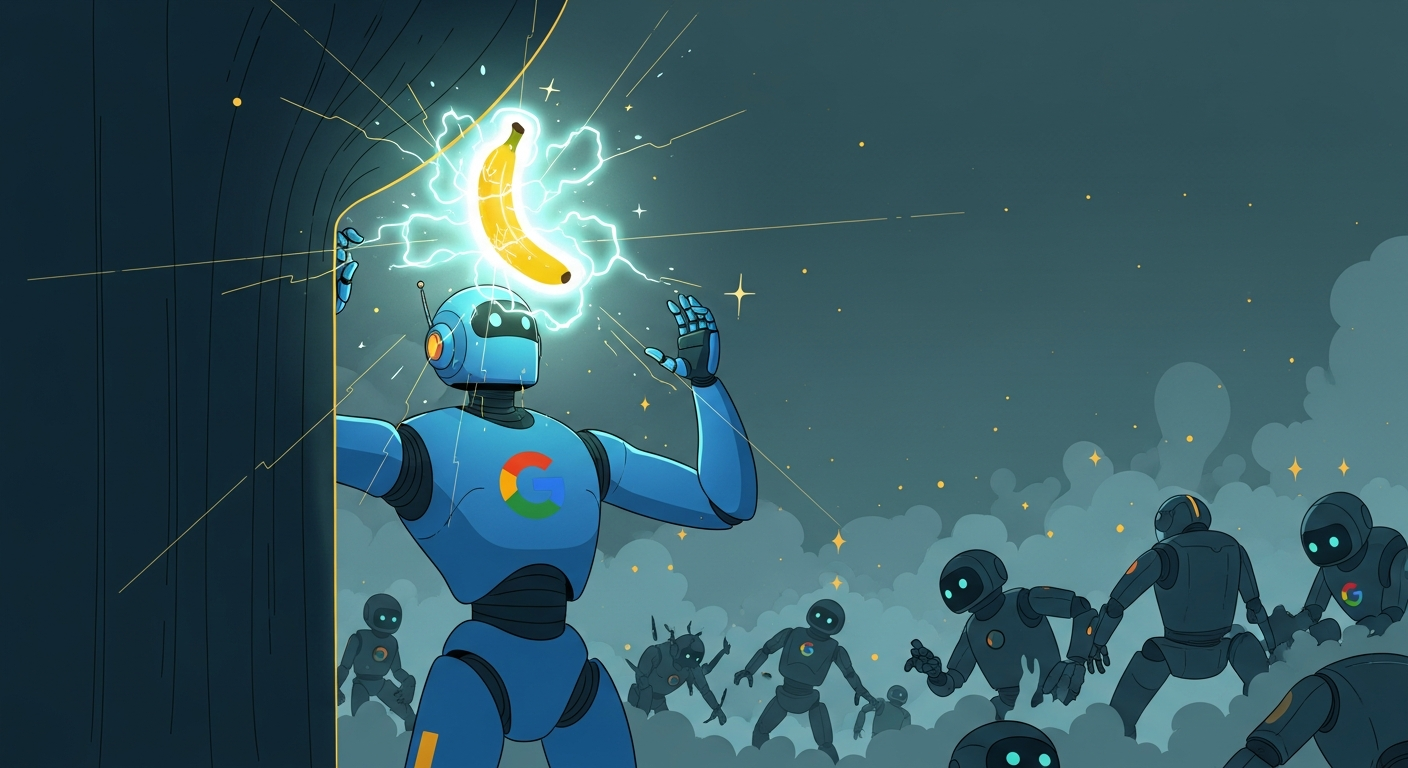
First up, Google's got everyone talking with the mysterious "Nano-Banana" model that suddenly appeared on LMArena battles and absolutely demolished the competition in image generation.
No official announcement, no documentation - just banana emojis from Google engineers and outputs that are making Canva and Adobe sweat.
This could be Gemini's secret weapon finally showing its hand.
Moving to hardware, NVIDIA just dropped their Jetson Thor robotics chip for dollar 3,499, packing 7.5 times more AI processing power than the previous generation.
Companies like Boston Dynamics and Agility Robotics are already integrating it, and with 2 million developers on NVIDIA's robotics platform, we're looking at a serious acceleration in real-world robot deployment.
In legal news, Elon Musk's xAI has filed a major antitrust lawsuit against both Apple and OpenAI, claiming their exclusive ChatGPT integration creates an illegal monopoly that locks out competitors like Grok.
This could set the first major precedent for AI market competition as the technology enters mainstream adoption.
Microsoft just released VibeVoice, an open-source text-to-speech model that can generate up to 90 minutes of multi-speaker conversational audio with just 1.5 billion parameters.
We're talking podcast-quality conversations with four different voices maintaining unique characteristics - and it's efficient enough to run on consumer devices.
Perplexity is making peace with publishers through a dollar 42.5 million revenue-sharing program, launching a dollar 5 monthly Comet Plus subscription that gives media outlets 80 percent of proceeds.
This comes amid active lawsuits from News Corp and cease-and-desist orders from Forbes and Condé Nast.
And finally, Silicon Valley heavyweights including Andreessen Horowitz and OpenAI's Greg Brockman have launched a dollar 100 million pro-AI super PAC called "Leading the Future" to influence the 2026 midterm elections and fight strict AI regulations.
DEEP DIVE ANALYSIS
Let's dive deep into NVIDIA's Jetson Thor launch because this represents a fundamental shift in how we think about AI deployment at the edge. The dollar 3,499 price point might seem steep, but we're looking at a technological inflection point that could reshape entire industries.
Technical Deep Dive
: The Jetson Thor delivers 2,070 teraflops of computing power in a package small enough to fit inside a robot's body. This is built on NVIDIA's Blackwell architecture - the same technology powering their latest data center chips. What makes this revolutionary is the real-time processing capability.
Previous generations required robots to send data to the cloud for complex decision-making, creating latency that made them clunky and unreliable. Thor processes data from multiple sensors simultaneously - cameras, radar, touch sensors - and makes split-second decisions locally. We're talking about the difference between a robot that stutters through tasks like it's buffering a YouTube video versus one that reacts as smoothly as a human.
Financial Analysis
: At dollar 3,499 for developer kits and dollar 2,999 per production unit for orders over 1,000, NVIDIA is pricing this as enterprise-grade infrastructure, not consumer electronics. But here's the key insight - this represents a massive cost reduction from previous solutions. Companies were previously spending tens of thousands on server-grade hardware to achieve similar performance.
NVIDIA's robotics division, combined with automotive, just reported dollar 567 million in quarterly revenue with 72 percent year-over-year growth. They're capturing value at the hardware layer while enabling an entire ecosystem of robotics companies to scale. The real financial story is the platform play - with 2 million developers already building on NVIDIA's robotics platform, they're creating a network effect where more developers attract more hardware buyers, which attracts more software partners.
Market Disruption
: This puts NVIDIA in direct competition with Intel's edge computing solutions and AMD's embedded processors, but more importantly, it's creating a new category of AI-first robotics. Companies like Figure AI, Boston Dynamics, and Agility Robotics are no longer competing just on mechanical engineering - they're competing on AI capabilities. The real disruption is in industries like warehousing, manufacturing, and healthcare.
Amazon's already using these chips in their warehouse robots, and that's going to force every logistics company to either upgrade their automation or fall behind competitively. We're seeing the same dynamic that made Tesla's over-the-air updates a competitive moat, but now applied to physical robots.
Cultural and Social Impact
: We're crossing the threshold where robots can handle unpredictable, real-world situations instead of just following pre-programmed routines. This means we're moving from robots that work in controlled factory environments to robots that can navigate chaotic city streets for delivery, assist in surgery where every patient is different, or provide eldercare that adapts to individual needs. The social implications are massive - we're talking about the first generation of robots that can truly integrate into human spaces and workflows.
But there's also the job displacement question. Stanford research shows AI is already eliminating entry-level positions first, and now we're giving robots the intelligence to handle mid-level physical tasks too.
Executive Action Plan
: First, if you're in manufacturing, logistics, or healthcare, you need to start pilot programs now. Don't wait for competitors to prove the ROI - the companies moving first will capture the operational advantages and talent. Second, consider partnership strategies with robotics companies rather than trying to build in-house.
The technical complexity of integrating AI, sensors, and mechanical systems is beyond most companies' core competencies, but you can leverage these platforms to create industry-specific solutions. Third, start planning your workforce transition strategy today. This isn't about replacing humans overnight, but robots with Thor-level intelligence will handle routine tasks while humans focus on higher-value work requiring creativity, complex problem-solving, and emotional intelligence.
Companies that proactively retrain and redeploy their workforce will maintain competitive advantage while those that don't will face disruption from more agile competitors.
Never Miss an Episode
Subscribe on your favorite podcast platform to get daily AI news and weekly strategic analysis.