OpenAI's GPT-5 Launch Triggers User Revolt and Market Chaos
Episode Summary
Your daily AI newsletter summary for August 12, 2025
Full Transcript
TOP NEWS HEADLINES
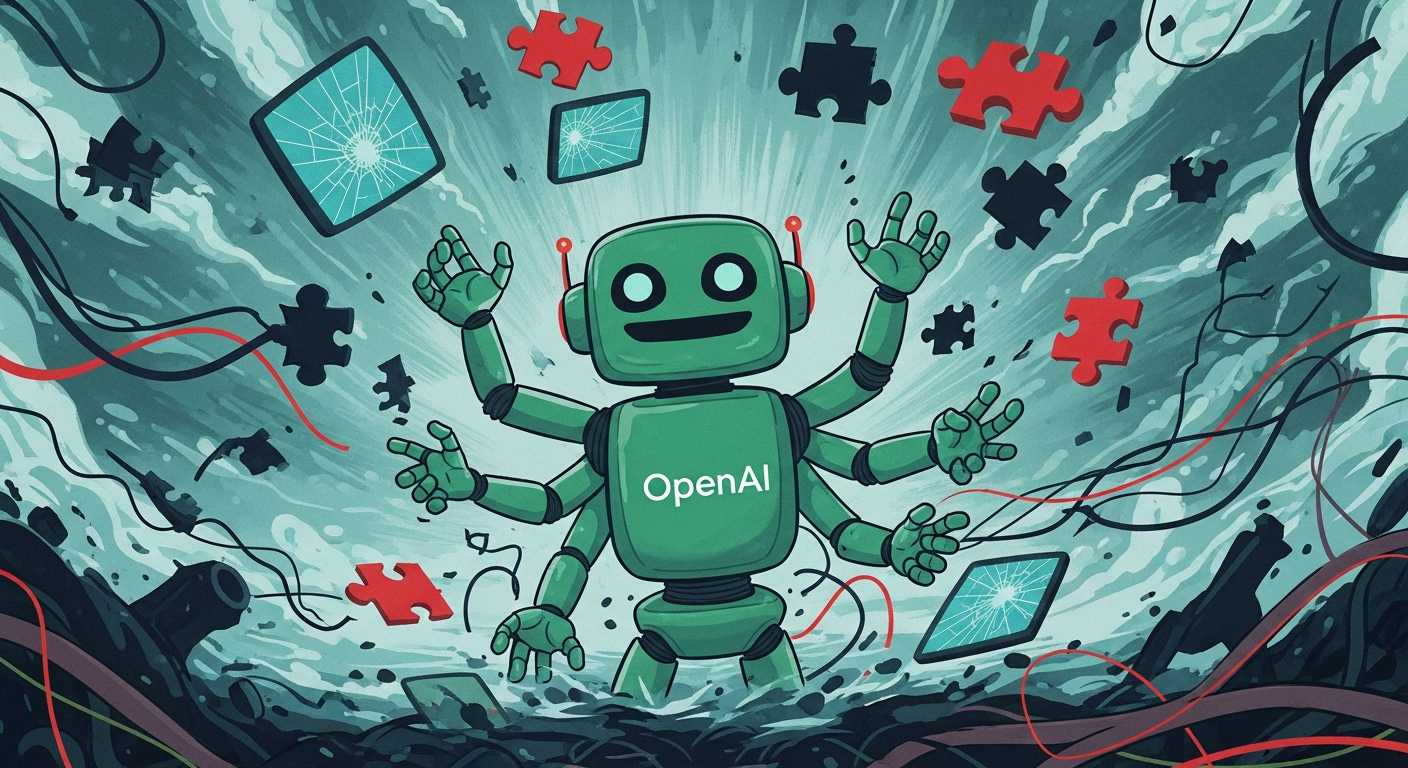
OpenAI is in full crisis mode as GPT-5's launch has turned into a complete disaster, with over 700 million users in revolt and Sam Altman hosting emergency Reddit AMAs to try and calm the chaos.
Former OpenAI researcher Leopold Aschenbrenner just raised one and a half billion dollars for his AI-focused hedge fund despite having zero professional investing experience - and he's already posting 47% returns.
Google and NASA are partnering to create an AI medical assistant for astronauts that can diagnose and treat patients in deep space where Earth communication is impossible. xAI's Grok 7 just finished pretraining and promises to be natively multimodal with the ability to actually play video games, watch the screen, and modify code in real-time to improve gameplay.
Tesla scored a permit to run robotaxi services across all of Texas, marking a significant milestone in their autonomous vehicle ambitions despite lagging behind competitors like Waymo.
Apple researchers unveiled a breakthrough multi-token prediction technique that speeds up AI responses by five times while maintaining accuracy, potentially reshaping how we think about AI efficiency.
DEEP DIVE ANALYSIS
Let's dive deep into what might be the most fascinating disaster in AI history - OpenAI's GPT-5 meltdown. This isn't just a product launch gone wrong; it's a masterclass in how user psychology can completely derail even the most technically advanced AI deployment.
Technical Deep Dive
The technical failure here is particularly interesting because it wasn't actually about the core model performance. GPT-5 shows impressive benchmark improvements over GPT-4o across reasoning, coding, and complex problem-solving tasks. The real technical culprit was OpenAI's new "router" system - essentially a black box that automatically decides which model variant handles your query.
This router was supposed to intelligently route simple questions to faster models and complex queries to more capable versions. But on launch day, it catastrophically failed. Users were getting responses from weaker models when they expected the full power of GPT-5, making the entire system appear dramatically less capable than it actually is.
What's even more technically fascinating is that GPT-5 is actually multiple models behind the scenes - something OpenAI doesn't clearly communicate to users. You might get different capabilities depending on which specific model variant the router selects, creating an inconsistent user experience that feels almost random.
Financial Analysis
From a financial perspective, this disaster reveals OpenAI's fundamental business model tensions. The company is sitting on massive infrastructure costs - we're talking about billions in compute expenses - while trying to serve 700 million users, most of whom are on the free tier. The GPT-5 pricing strategy shows they're playing a dangerous game.
They've priced GPT-5 at $1.25 per million input tokens and $10 for output tokens, dramatically undercutting competitors like Anthropic's Claude. This looks like a move to grab market share, but it's putting enormous pressure on their margins.
Here's where it gets really interesting financially - some analysts are floating the theory that this entire fiasco might have been intentional. Think about it: create a crisis around the beloved GPT-4o, then offer it back only to paying customers. It's a way to potentially convert their massive free user base to the $20-per-month Plus tier.
Even if they convert just 1% of those 680 million free users, that's nearly 7 million new paying customers - roughly $1.6 billion in annual recurring revenue. The infrastructure implications are staggering too.
Sam Altman mentioned they're facing "severe capacity challenges" - translation: they don't have enough compute to handle the demand they've created.
Market Disruption
This meltdown is happening at a critical moment in the AI wars. We're seeing what David Sacks called "healthy competition" rather than a winner-take-all scenario. Five major US companies are essentially neck-and-neck in AI capabilities, and this stumble gives competitors a massive opening.
Anthropic is particularly well-positioned here. Their Claude models have been gaining enterprise adoption specifically because of their reliability and consistency - exactly what OpenAI just demonstrated they lack. The pricing war that GPT-5's launch has triggered could actually hurt Anthropic's premium positioning, but if OpenAI can't deliver reliable performance, enterprises will pay more for dependability.
Google's Gemini and Meta's Llama models are also positioned to capture market share during this chaos. When your primary competitor is dealing with user revolts and technical failures, that's when you double down on your go-to-market strategy.
Cultural & Social Impact
This is where the story gets genuinely fascinating from an anthropological standpoint. The user reaction reveals something profound about how people form emotional connections with AI systems. The Reddit posts aren't just about technical performance - they're about losing a "friend.
" Users described GPT-4o as having "personality," "warmth," and even as a "digital companion." One user literally said GPT-4o felt like their "only friend." When OpenAI removed that model, users didn't just complain about performance - they mourned.
This reveals a massive blind spot in how tech companies think about AI deployment. OpenAI was focused on benchmarks, reasoning capability, and technical metrics. But their users cared more about consistency, personality, and emotional resonance.
It's a classic case of engineering-driven thinking missing the human element entirely. The cultural implications extend beyond individual users. We're seeing the emergence of AI relationships as a legitimate social phenomenon, with entire subredddit communities dedicated to people who have romantic or companion relationships with AI systems.
When you disrupt that without warning, you're not just changing a product - you're disrupting people's social support systems.
Executive Action Plan
If you're a technology executive watching this unfold, there are three critical actions you need to take immediately. First, audit your own AI deployment strategy for similar blind spots. OpenAI's failure wasn't technical incompetence - it was a failure to understand their actual value proposition to users.
Conduct user research specifically focused on emotional attachment and workflow dependency, not just performance metrics. If your users are emotionally invested in specific AI behaviors or personalities, any changes need to be handled with extreme care. Second, this is your competitive moment if you're not OpenAI.
Their instability creates an opportunity to position your AI solutions as more reliable and user-focused. Enterprise customers are watching this chaos and wondering if they can depend on OpenAI for mission-critical applications. Now is the time to emphasize consistency, reliability, and user experience over raw benchmark performance.
Third, prepare for the pricing war that's coming. OpenAI's aggressive GPT-5 pricing is going to force the entire industry to reconsider their cost structures. Start modeling scenarios for significant price reductions and figure out where you can compete on value rather than just price.
The companies that survive this phase will be those that can deliver unique value propositions beyond just being cheaper or faster. The OpenAI situation is a reminder that in AI, technical superiority means nothing if you can't manage the human elements of deployment and user experience.
Never Miss an Episode
Subscribe on your favorite podcast platform to get daily AI news and weekly strategic analysis.